Great fruit is growing right in our own backyard.
But without proper care, the apples, peaches and berries - among others - that could be free major food sources for community members, could wither away.
Changing that could be as simple as proactively pruning your fruit tree, or in the case of a plum tree in the Two Rivers community garden on Sunday, some grafting work may need to be done.
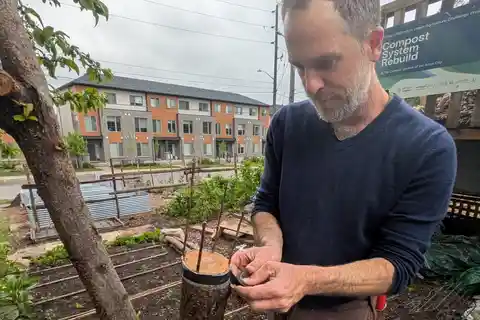
Matt Soltys, owner of The Urban Orchardist, was on site this past weekend to do topworking work on a tree suffering from a disease called black knot.
"Some plums are quite susceptible to (black knot)," he said.
Two Rivers
"The disease can easily take over and kill the tree. Instead of letting this tree succumb to this disease, there's a method of grafting called topworking."
He also taught the skill to those in attendance.
Soltys essentially cut back most of the tree, and put disease-resistant scions - or new wood - into it.
"If the grafting is successful, then that mature root system of the tree - that's already quite mature - that can pump out growth into the scion, and more quickly regrow a more disease-resistant tree of good eating quality in that same place, without having to cut the tree down, take the roots out and plant the new tree," Soltys said.
He said at the expense of a branch from a better tree, the act can replace what that tree is producing.
Soltys
"There's lots of apples, pears, many different types of plums, peaches even grow well in Guelph," Soltys said.
"Then there's unique species like the native pawpaw, that also produces a really interesting mango-pear-banana flavoured fruit."
He said operating the former Guelph Fruit Tree Project in the 2000s opened his eyes on what is growing in people's backyards, and the project allowed them to get a directory of people with trees in their backyard, but weren't making the best use of them.
Groups of volunteers would harvest the fruit and deliver it to shelters and food banks.
This was part in parcel with why he started The Urban Orchardist, to provide services like consulting and pruning.
Guelph Fruit Tree Project
He said signs of disease moving through a tree are usually pretty obvious.
"People call me often and they say 'something doesn't look quite right with my tree," Soltys said.
"There's all these spots on the leaves, or there's spots on the fruit, or all the fruit drops in June for some unknown reason, or this tree has an oozing wound,' those are usually the things."
But just because a tree is fully healthy, regular maintenance shouldn't be neglected.
"There is also good reason to be proactively caring for the tree, even when there's not obvious signs because annual pruning, for example, can keep a tree relatively small and producing sweet fruit relatively low, rather than only producing fruit ever higher each year, out of your reach eventually," Soltys said.
What to expect
Soltys said moving forward, he is trying to find people with fruit trees in semi-public areas, like the side of a yard or an alleyway, that may not be producing the best fruit.
"I'd love to use topworking to graft those semi-public, but poor quality trees, to turn them over into high quality trees that anyone can (use)," he said.
Some plums are quite susceptible to (black knot).
Putting it in context
The further produce travels, the more compromise is involved, which is why local supply still shapes menus in ways that price alone cannot explain.
Key takeaways
- Great fruit is growing right in our own backyard
- Without proper care, the apples, peaches and berries - among others - that could be free major food sources for community members, could wither away
- Changing that could be as simple as proactively pruning your fruit tree, or in the case of a plum tree in the Two Rivers community garden on Sunday, some grafting work may need to be done
- Matt Soltys, owner of The Urban Orchardist, was on site this past weekend to do topworking work on a tree suffering from a disease called black knot
- "Some plums are quite susceptible to (black knot)," he said
Common questions
What should you know about Soltys?
Matt Soltys, owner of The Urban Orchardist, was on site this past weekend to do topworking work on a tree suffering from a disease called black knot.
Why does it matter?
just because a tree is fully healthy, regular maintenance shouldn't be neglected.
The bottom line
As always in the produce section, the gap between what gets announced and what actually reaches people is where the real story will be decided.