I have recently written a lot about the phenomenon of the Judgement of Wimbledon Blind Grenache Tasting held in London and its enduring growth, success and longevity - 2026 marking its 10th anniversary and it still going strong, mirroring the global rise of premium Grenache. But there is another ongoing tasting I'm involved with annually that is slowly building a steady head of steam: The Norfolk Wine Weekend (NWW).
This three-day, full-immersion wine weekend, held every June or July at a fellow South African friend's Norfolk "cottage", allows six or seven collectors and connoisseurs to gather each year to conduct a series of fabulous blind vertical and horizontal tastings. Some years, the main event is a Bordeaux Cru Classé blind horizontal; other years, a Skurfberg Chenin Blanc vertical - but always a diverse, enlightening selection that's a lot of fun.
Already a few years back, out of respect for the premium category of South African Chenin Blanc, the group at the NWW started to assemble an annual blind Chenin Blanc horizontal tasting, and last year saw the 2020 vintage placed under the spotlight for assessment and analysis. I was reminded of that tasting after a mate recently pulled a case of 2020 from a prominent producer only to be disappointed by the condition of the wine...
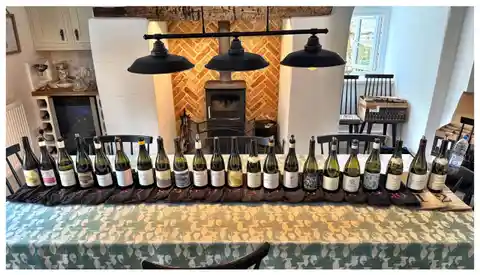
At NWW 2025, 22 premium examples were assembled, rated by the seven tasters using the 100-point scoring system, with the lowest score for each wine discarded to help reduce "outliers" once the scores were averaged.
Of course, the 2020 vintage in South Africa will forever be defined by a paradox: a near-perfect growing season for premium Chenin Blanc that collided with the most existential crisis in the history of the Cape wine industry. To understand this vintage is to look at a year of "pristine isolation", where the absence of heatwaves and a long, moderate ripening period produced wines of crystalline purity - even as wineries themselves faced the prospect of total collapse due to COVID-19 lockdown restrictions.
Chenin Blanc
For premium Chenin Blanc, the variety that has become the torchbearer for South Africa's "new wave", 2020 supposedly represented a pivot towards elegance and structural longevity, marking a departure from the heavier, more tropical profiles of the drought-stricken years that preceded it. With this perception firmly lodged in tasters' minds, we were all keen to see if it rang true, and whether the COVID-19 vintage would ultimately be viewed as a great success under duress.
In general, the 2020 vintage - which followed the gruelling multi-year drought (2015-2019) that had tested the resilience of South Africa's old vine heritage - was promoted as a turning point for the industry, with reservoirs replenished after improved winter rains. However, the defining characteristic of the 2020 growing season was not just water, but temperature profile.
Unlike many recent vintages marred by sudden, searing February heat spikes, 2020 was characterised by a cool, moderate summer. This was supposedly particularly beneficial for Chenin Blanc, a grape notoriously sensitive to sunburn and rapid sugar accumulation. The lack of extreme heat should have allowed for excellent acid retention, slow and steady flavour concentration with lower alcohols, and smaller berries contributing extra weight, texture and grip.
Obviously, one cannot critique the quality of the 2020 vintage without acknowledging the logistical nightmare endured by producers and growers. On 26 March, South Africa entered one of the world's strictest lockdowns. Initially, the wine industry was deemed "non-essential", threatening to leave 20% of the crop to rot on the vines. A last-minute concession allowed the harvest to continue, but the psychological and financial strain on winemakers remained immense.
With tasting rooms closed and exports banned, winemakers were confined to their cellars - forced into singular focus, free from the usual distractions of marketing and tourism that accompany harvest in February, March and April. The assessment at the time was that this isolation might result in meticulously attentive winemaking, with every decision taken with almost monastic focus and intensity.
South Africa
Looking back, the Cape wine industry's impression of the 2020 Chenin Blancs was emphatically positive. The wines were widely hyped, described as possessing "vibrancy and nerve", with "freshness, structural elegance and clear terroir transparency" - a vintage to buy for the cellar.
At this point, I should probably reveal a few hard truths and conclusions from this fascinating 22-wine tasting. But first, the line-up, with average blind scores (lowest outlier removed):
If truth be told, the tasting proved very, very interesting. If it can be summed up in one word, it would have to be "underwhelming". Of course, the usual caveats apply: scores tend to come in a point or two lower when tasted blind, and averaging across tasters suppresses extremes. What matters more are the trends and group observations.
Some readers - and perhaps a few winemakers - may feel the scores are unduly harsh compared to release ratings. To that I'd say: shift them all up a point or two if you like; it won't materially change the overall picture.
At release, the wines were described as those that "do not shout with the exuberant ripeness of a hot year; rather, they whisper of their site and soil with a clear, resonant voice." Sadly, five years on, that whisper has, in some cases, faded to more of a whimper. The showing may also challenge the notion that hotter, drier, riper years are necessarily inferior for Chenin Blanc - the 2016 vintage being a case in point, combining depth and ripeness with remarkable freshness.
Chenin Blancs
Overall, 2020 proved a relatively level playing field. Stellenbosch expressions varied subtly by terroir, particularly in Polkadraai Hills and the would-be ward of Helderberg, yielding wines with freshness, granitic spice and fynbos-tinged sapidity. Swartland wines tended towards precision over power, reflecting the realities of dry-farmed bush vines in warm conditions.
Mullineux's single-terroir wines showed particularly well, while Sadie Family Wines Skurfberg and Mev. Kirsten displayed their characteristic mineral austerity and "salted lemon" intensity - though, as ever, the latter clearly requires more time in bottle.
The broader trend, however, pointed to acidities that, in some wines, felt a little flat. Acidity, of course, underpins vibrancy, minerality and structure, and without it, the "whisper" of terroir becomes harder to discern.
Across my notes and those of the group, recurring phrases included "lacks complexity", "light on acid", "slightly unfocused", "straightforward" and "needs more acid". On the plus side, oak usage was generally intelligent and sympathetic, and the wines were texturally sleek, soft, supple and harmonious. In short, many are drinking well now and will continue to do so over the next two to three years.
Many Winemag readers periodically grumble that not enough guidance is offered on when to drink premium South African whites. In this case, the consensus was clear: drink sooner rather than later - not because the wines are about to fall apart, but because they are unlikely to improve significantly, and many lack the acidity for extended ageing.
Skurfberg and Mev Kirsten
It has been suggested that any critique of Chenin Blanc - South Africa's "golden child" - may not be well received. To that I would counter: these are not inexpensive wines, and consumers deserve to know how they are performing.
To the victors, the spoils. Hats off to the top five:
Lastly, I can report that among the seven NWW tasters, a considerable amount of premium 2020 Chenin Blanc remains in cellar. We all resolved - without exception - to break the shackles of collector hesitancy and start drinking more of these wines now. Readers should feel confident to do the same.
Next year, we move on to the much-anticipated 2021 vintage. That should be a tasting not to be missed.
freshness, structural elegance and clear terroir transparency
Key takeaways
- At NWW 2025, 22 premium examples were assembled, rated by the seven tasters using the 100-point scoring system, with the lowest score for each wine discarded to help reduce "outliers" once the scores were averaged
- The 2020 vintage in South Africa will forever be defined by a paradox: a near-perfect growing season for premium Chenin Blanc that collided with the most existential crisis in the history of the Cape wine industry
- Unlike many recent vintages marred by sudden, searing February heat spikes, 2020 was characterised by a cool, moderate summer
All told
None of this settles the wider question. It does make one thing harder to ignore: the pressure on the drinks list has shifted, and others will have to respond to it.