In the heart of the San Francisco Ferry Building, a different kind of culture is growing, one rooted in food, science and community.
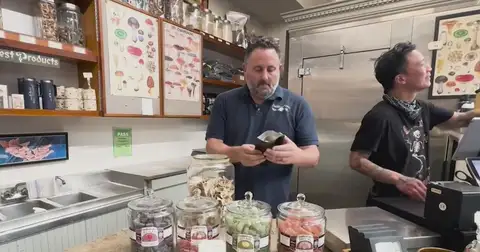
At Far West Fungi, CEO Ian Garrone showcases a range of cultivated mushrooms that are gaining popularity among Bay Area consumers.
"These are maitake mushrooms that we grow at our farm, certified organic. They're wonderful. They've got kind of a roasted chicken flavor to them," Garrone said.
San Francisco Ferry Building
Garrone said interest in mushrooms has surged in recent years, particularly following the COVID-19 pandemic, as consumers explore both culinary and health-related uses.
"You know, I think it's amazing how much it has actually expanded in the last couple years, especially after COVID," he said. "I think people are really interested in both the medicinal side of mushrooms and also the culinary side."
As mushrooms gain traction as both a gourmet ingredient and a wellness product, Garrone said curiosity is also growing around psychedelic varieties -- and their legal status.
Bay Area
"So, we do field a lot of questions when it comes to the legalities of it," he said.
That curiosity extends beyond the marketplace and into research institutions such as UC Berkeley Center for the Science of Psychedelics, where scientists are studying the potential therapeutic benefits of psychedelic compounds.
"Psilocybin mushrooms are in the most restricted legal category, and so the only way, in terms of federal law, for people to have legal psychedelic experiences with psilocybin is in a clinical trial," said Dr. Michael Silver, a researcher with the center.
UC Berkeley Center
Silver said early findings suggest promise in treating certain mental health conditions, though more research is needed.
"There are still many more clinical trials that need to be done, but there are also enough clinical trials now to show that there is promise of psychedelic-assisted therapy being effective and being something that leads more toward a cure, rather than chronic symptom control," he said.
In the Bay Area, where diverse communities have long shaped the food landscape, mushrooms continue to reflect a blend of cultures and traditions.
What you need to know
"There are so many different ethnic groups that are here, represented, and so we have a lot of varieties of different mushrooms used in different areas, and they are all brought together here and enjoyed," Garrone said.
From plate to possibility, the Bay Area's mushroom scene continues to grow.
These are maitake mushrooms that we grow at our farm, certified organic. They're wonderful. They've got kind of a roasted chicken flavor to them.
Putting it in context
The further produce travels, the more compromise is involved, which is why local supply still shapes menus in ways that price alone cannot explain.
What to remember
- In the heart of the San Francisco Ferry Building, a different kind of culture is growing, one rooted in food, science and community
- At Far West Fungi, CEO Ian Garrone showcases a range of cultivated mushrooms that are gaining popularity among Bay Area consumers
- "These are maitake mushrooms that we grow at our farm, certified organic
- Garrone said interest in mushrooms has surged in recent years, particularly following the COVID-19 pandemic, as consumers explore both culinary and health-related uses
- "You know, I think it's amazing how much it has actually expanded in the last couple years, especially after COVID," he said
What people ask
What should you know about Bay Area?
At Far West Fungi, CEO Ian Garrone showcases a range of cultivated mushrooms that are gaining popularity among Bay Area consumers.
What happens next?
In the Bay Area, where diverse communities have long shaped the food landscape, mushrooms continue to reflect a blend of cultures and traditions.
All told
As always in the produce section, the gap between what gets announced and what actually reaches people is where the real story will be decided.