
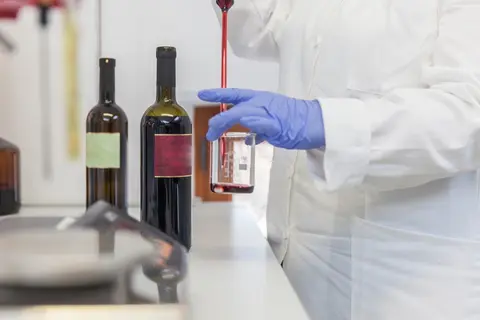
Affinity Labs, part of the Australian Wine Research Institute (AWRI), is celebrating 40 years of continuous accreditation from National Association of Testing Authorities (NATA), a milestone highlighting its long-standing role supporting the food and beverage industry.
Formerly known as the AWRI Technical Service Laboratory, the facility first achieved NATA accreditation in 1986, becoming one of the earliest accredited laboratories in the Australian wine sector. The development coincided with a surge in exports to the European Economic Community, when VI-1 analytical certification became mandatory for wine entering the market.
During this period, Australian wine exports grew dramatically, expanding from around three per cent of a 400,000-tonne vintage in 1983 to 60 per cent of nearly two million tonnes by 2000. The rapid expansion placed increased demands on analytical capability, traceability and quality assurance across the industry.
Australian Wine Research Institute
Mark Krstic, Managing Director of AWRI, said: "For four decades, Affinity Labs have been the analytical backbone that Australian wine producers rely on. As we have expanded our customer base, our NATA-accredited methods have given customers, and the markets they supply, absolute assurance their food and beverage products stand up to the rigours of safety, labelling and composition Standards. As consumer demands continue to evolve, that assurance has never been more important."
The laboratory began in the early 1980s providing analytical support to wineries, led by industry figures Terry Lee, Gary Baldwin and Ken Pocock. Early collaborations also involved Australian Mineral Development Laboratories (AMDEL), which supported metal testing and broader technical capability.
Following accreditation, AWRI established an inter-winery analysis group to assist producers pursuing their own NATA accreditation, helping strengthen national capability as exports accelerated. In 2001 the organisation also gained recognition under the Organisation for Economic Co-operation and Development (OECD) Principles of Good Laboratory Practice (GLP) for non-clinical agrochemical residue testing.
Managing Director of AWRI
Heather Mackenzie, General Manager - Commercial Services, said the milestone reflects the lab's ongoing commitment to accuracy and technical competence.
"NATA accreditation acts as a benchmark for technical competence and provides our customers with confidence they are receiving accurate results," she said.
"Reaching 40 years of continuous NATA accreditation is central to maintaining Affinity Labs' reputation as Australia's leading supplier of analytical and consulting services to food and beverage producers."
Mackenzie General Manager
Today Affinity Labs offers a wide range of consulting and analytical services across the food and beverage sector, including chemical and microbiological testing, sensory analysis and export certification for global markets.
In 2025 alone the laboratories processed nearly 23,000 samples, generating around 35,000 accredited analyses using 16 NATA ISO/IEC 17025 methods. Across both ISO/IEC 17025 and OECD GLP programs within the Analytical and Trace Laboratories, more than 100,000 analyses are conducted each year, reflecting the scale of demand for accredited testing services supporting Australian food and beverage exports.
NATA accreditation acts as a benchmark for technical competence and provides our customers with confidence they are receiving accurate results.
Reading the wider picture
What ends up in the glass is only half the story. Packaging, pricing and placement decide how far a drink actually travels.
Key takeaways
- Affinity Labs, part of the Australian Wine Research Institute (AWRI), is celebrating 40 years of continuous accreditation from National Association of Testing Authorities (NATA), a milestone highlighting its long-standing role supporting the food and beverage industry
- During this period, Australian wine exports grew dramatically, expanding from around three per cent of a 400,000-tonne vintage in 1983 to 60 per cent of nearly two million tonnes by 2000
- Mark Krstic, Managing Director of AWRI, said: "For four decades, Affinity Labs have been the analytical backbone that Australian wine producers rely on
- "NATA accreditation acts as a benchmark for technical competence and provides our customers with confidence they are receiving accurate results," she said
- "Reaching 40 years of continuous NATA accreditation is central to maintaining Affinity Labs' reputation as Australia's leading supplier of analytical and consulting services to food and beverage producers."
By the numbers
- Wine Research Institute (AWRI), is celebrating 40 years of continuous accreditation from National Association of Testing Authorities (NATA), a milestone
- Formerly known as the AWRI Technical Service Laboratory, the facility first achieved NATA accreditation in 1986, becoming one of the earliest accredited laboratories in the Australian wine sector
- In 2001 the organisation also gained recognition under the Organisation for Economic Co-operation and Development (OECD) Principles of Good Laboratory Practice (GLP) for non-clinical agrochemical residue testing
- In 2025 alone the laboratories processed nearly 23,000 samples, generating around 35,000 accredited analyses using 16 NATA ISO/IEC 17025 methods
Questions worth asking
What should you know about Affinity Labs?
Affinity Labs, part of the Australian Wine Research Institute (AWRI), is celebrating 40 years of continuous accreditation from National Association of Testing Authorities (NATA), a milestone highlighting its long-standing role supporting the food and beverage industry.
Why does it matter?
As consumer demands continue to evolve, that assurance has never been more important.".
All told
None of this settles the wider question. It does make one thing harder to ignore: the pressure on the drinks list has shifted, and others will have to respond to it.