Corn is omnipresent in Nicoya: it is in lunches, murals, on the facade of the church, and also in drinks. Our indigenous heritage makes this seed a central part of both everyday life and ceremonies.
We have it daily in a tortilla or a rosquilla, in "arroz de maíz" when we celebrate a town festival during the year, and less and less frequently, when we drink a glass of cold chicha.
According to Nicoya writer and customs expert Carlos Aráuz, chicha, along with chicheme, tiste, and pitarría, are the main drinks of the Virgen de Guadalupe festivities in Nicoya. But little by little, chicha has been disappearing, and fewer and fewer people are making it. Luckily, there are some, like Liliana, who persist.
Liliana Matarrita Piñar places a wooden tray on a bench in front of her kitchen, which is located at the back of her house in Corralillo de Nicoya. Outside the kitchen is a clay oven on the verge of collapse, which now serves as a nest for chickens. Inside the kitchen is the wood-burning stove where she will cook the chicha.
In the tray, covered with banana leaves she cut from her own yard, is the sprouted corn she will use to prepare the drink.
Corralillo de Nicoya Outside
Small sprouts emerge from the yellow kernels, creating a large web of intertwined seeds. They have been like this for several days of work. Liliana soaked the corn overnight. The next morning, she spread it out on the tray covered with a banana leaf, covered it with another leaf on top, and sprinkled it with water for four days in a row so that the roots would sprout.
It looks beautiful. Those roots are life. I like to go camping, to the mountains, and everything that is nature, and this is a natural thing," says Liliana proudly as she watches her corn sprout.
Now, with tremendous patience and strength, Liliana begins to grind all the corn by hand, then dissolves the dough in water and strains it to remove the corn peel. She then cooks it over high heat for an hour. Halfway through cooking, Liliana adds a whole lid of brown sugar so that it melts.
Every time she takes out a guacal to put it back into the pot and stir the chicha, the wooden room fills with thick white steam that mixes with the smoke from the stove. She continues until it becomes a thick, chocolate-colored liquid.
She takes it off the heat and strains it again "because the sweetness attracts things like wasps." Finally, all that's left is to bottle it and wait three days for the fermentation to do its thing.
Liliana
After almost a whole week of devotedly caring for the seeds, spending the morning grinding them by hand, and cooking over a wood fire with a suffocating cough, Liliana sells a gallon of chicha for ¢7,500 (about $15).
I was a little girl and I remember my great-grandmother making it, but I didn't know how. One day, a cousin of my dad's, who is now about 85 years old, said to me, 'I want us to make chicha like Grandma used to make,' and then he told me how to do it," Liliana recalls.
At 68, she has mastered the subtleties of preparing chicha: not letting the corn sprout for too long because if green leaves sprout, the chicha becomes bitter. Choosing large-grain corn "that isn't dormant, small, or ugly." And it must also be quite yellow so that it transfers that bright color to the chicha.
Liliana knows of some families in her community who used to prepare the drink for the prayers of "San Chombo" or San Jerónimo to help them with their harvests, but those who maintained that tradition have now passed away. She no longer makes it for any festivities or prayers, only investing her time and labor when someone orders the drink from her.
At the Virgen de Guadalupe festivities in Nicoya, it is common to find tiste or chicheme, but according to Nicoya researcher Mario Rojas, chicha is no longer one of the main attractions.
Virgen de Guadalupe
A small amount is usually made, as a sample, but people no longer drink it culturally, so it has fallen into disuse," explains Rojas.
However, this cultural change did not happen overnight, nor was it accidental or recent. Historian Patricia Vega, in her research article Consumo de licor, publicidad y diversiones en Costa Rica (1900-1930) (Liquor Consumption, Advertising, and Entertainment in Costa Rica (1900-1930)), explains that the 1907 tax code required grocery store owners who had not obtained a liquor license to refrain from selling chicha.
Beyond the legal prohibitions on the sale of chicha and homemade aguardiente that came with the creation of the National Liquor Factory (Fanal), chicha was stigmatized and considered inferior to imported liquors.
The same article highlights that during Christmas, if you had the financial means, chicha was replaced by drinks considered more "refined."
Food and drink are symbolic elements used to express distinction. Drinking cognac is an indicator that one is in a financial position to upgrade from chicha to a quality liquor that only those who can afford it can offer to their guests," explains the historian in the text.
Consumption Advertising and Entertainment
This phenomenon did not occur only in Guanacaste or Costa Rica, but is a product of colonization throughout Latin America.
But the gastronome also invites us to reconnect with this ancestral drink, which plays a fundamental role "in connecting indigenous peoples with each other, with spirituality, with nature, and with agricultural seasonality through this living beverage."
"For these and many other reasons, chicha became ubiquitous in various cultures in the Americas. Perhaps because of this symbolic power and its deep connection to indigenous populations, both chicha and other fermented beverages were quickly subjected to colonization and eradication from the first encounters with Europeans. Although these events occurred in different territories, in different cultures, and at different times, they were woven together by the same thread," Macías notes.
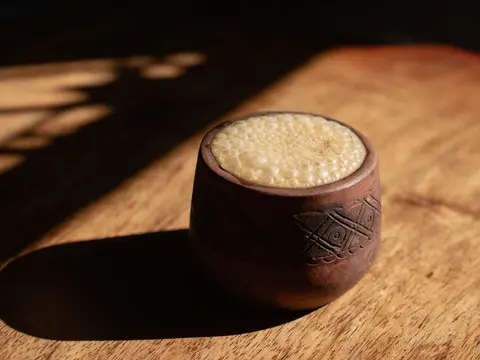
As the days pass, fermentation causes the chicha to bubble like an active volcano. The sweet taste of the first batches will give way to more vinegary ones, but without losing the fragrance of corn and corn husks.
Liliana does not drink chicha because she says it is hard on her stomach. She confesses that what she likes most about making the drink is that it makes her money. She does not speak romantically about preserving the recipe, nor does she idealize her work. She finds it perfectly normal to shelter the corn for almost a week and slowly hydrate it so that it grows. Nor does she feel like a hero for pouring an indigenous heritage into the guacal that, after 500 years of mistreatment, continues to bubble.
because the sweetness attracts things like wasps.
Putting it in context
The drinks business rewards patience. Recipes get refined quietly, formats get resized, and the label often changes long before anyone notices the liquid has.
At a glance
- Corn is omnipresent in Nicoya: it is in lunches, murals, on the facade of the church, and also in drinks
- In the tray, covered with banana leaves she cut from her own yard, is the sprouted corn she will use to prepare the drink
- With tremendous patience and strength, Liliana begins to grind all the corn by hand, then dissolves the dough in water and strains it to remove the corn peel
- Every time she takes out a guacal to put it back into the pot and stir the chicha, the wooden room fills with thick white steam that mixes with the smoke from the stove
- I was a little girl and I remember my great-grandmother making it, but I didn't know how
The questions it raises
What should you know about Liliana?
Liliana Matarrita Piñar places a wooden tray on a bench in front of her kitchen, which is located at the back of her house in Corralillo de Nicoya.
Why does it matter?
At 68, she has mastered the subtleties of preparing chicha: not letting the corn sprout for too long because if green leaves sprout, the chicha becomes bitter.
What happens next?
Inside the kitchen is the wood-burning stove where she will cook the chicha.
In short
The details will firm up over the coming months. What is already clear is that this is unlikely to be the last we hear of it.