
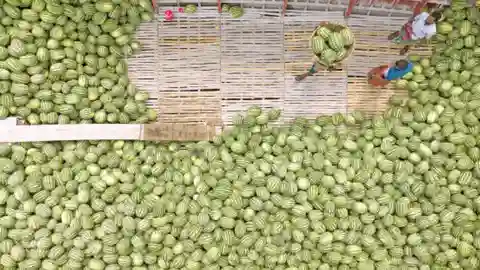
Before the city fully wakes, Badamtoli Ghat starts acting in full swing.
In the grey light before dawn, engine-run boats and heavy trawlers nudge their way to the bank of the Buriganga, riding low in the water under the weight of their cargo. They carry hundreds upon hundreds of watermelons hauled fresh from the fields of Bhola, Patuakhali and Barishal.
By the time the sun climbs high enough to bake the rooftops of Old Dhaka, the nation's largest wholesale fruit market - Badamtoli Ghat - is in full, thunderous motion.
Bhola Patuakhali and Barishal
The narrow, winding alleys of the dockyard go vanished beneath walls of stacked fruit. Porters move in steady streams, balancing loads on their heads with the practiced ease of men who have done this every March for as long as they can remember.
Traders call out prices. Buyers argue back. And when the sun drops and the lanterns flicker on over the Buriganga, the trading simply continues - because in Badamtoli, the watermelon season waits for no one.
Farmer Md Dulal Mia arrived there with a trawler-load of watermelons grown on his land in Barguna, and by morning he had already begun his calculations.
Md Dulal Mia
At Badamtoli, he sells by the piece. Large watermelons, weighing between six and 10kgs, go for Tk12,000 to Tk14,000 per hundred, while the smaller ones fetch Tk5,000 to Tk7,000, he told this correspondent.
It is the retailers who will later weigh them out to the gram and sell by the kilogram to the city's consumers - a transformation in how the fruit is priced that happens the moment it crosses into Dhaka, and nowhere else along its journey from field to table.
This year's harvest has arrived in greater volume than last, but the fruit is running smaller, the result of unsettled weather during the growing season.
The bigger picture
Seller Md Habib Hawlader, who cultivated watermelon across 10 bighas of land, said the smaller size had nudged prices downward.
Still, he remains cautiously hopeful. After deducting cultivation costs, he expects to clear between Tk50,000 and Tk100,000 profit per bigha.
Not everyone at Badamtoli, however, greets the season with uncomplicated joy. Wholesaler Ahsan Ullah of Waizghat has grown weary of an annual ritual of blame directed at traders the moment prices rise.
Ahsan Ullah of Waizghat
The reality, he says, is more complicated than it appears from the outside.
Beyond the purchase price paid to farmers, there are transport costs, unloading costs, and the constant fluctuation of quality that makes every consignment a fresh gamble. "Even though we buy watermelons by the piece, the price fluctuates based on their size and quality," he said, with the quiet frustration of a man who has explained this many times before.
In Badamtoli, the watermelon is, for a few intense weeks each March, the seasonal pulse of a city's economy - hauled upriver in the dark, sold in the din of the day, and carried home in baskets across a sweltering, thirsty capital.
Even though we buy watermelons by the piece, the price fluctuates based on their size and quality.
Reading the wider picture
Fresh produce runs on seasons that ignore calendars, and most supply problems begin as nothing more complicated than weather in the wrong week.
The short version
- Before the city fully wakes, Badamtoli Ghat starts acting in full swing
- By the time the sun climbs high enough to bake the rooftops of Old Dhaka, the nation's largest wholesale fruit market - Badamtoli Ghat - is in full, thunderous motion
- Farmer Md Dulal Mia arrived there with a trawler-load of watermelons grown on his land in Barguna, and by morning he had already begun his calculations
- Seller Md Habib Hawlader, who cultivated watermelon across 10 bighas of land, said the smaller size had nudged prices downward
- The reality, he says, is more complicated than it appears from the outside
In short
How this plays out in the produce section will take time to become clear. For now it is a development worth following rather than judging.