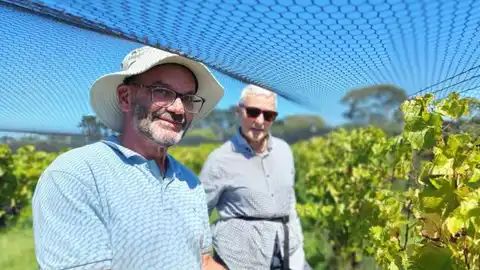
"I like this kind of ending one chapter and starting the next chapter," Corban said.
"This is the end of the grape growing and the start of the wine making, so it's a nice point.
"I like seeing the fruit come in."That's six months' work, maybe longer, and it's just gorgeous on days like this.
"You know, it's no hardship, is it?"The couple were among 90% of New Zealand's 700-plus winegrowers classified as "small" - producing under 200,000 litres a year.
With their own winery on site, they produced about 20,000 litres, although that varied from year to year.
Jeremy and I
Jacobs described it as a classic family-run operation.
"We try and do all the work ourselves. We're organic. We're living on our property. Our children grew up here.
"We love the fact that it's really simple and compact, and we pick as much fruit in a day as we can, Jeremy and I can, process, so we've got a lot of friends who've been involved with us since the beginning."
The pickers were treated to a nice lunch at the end - "A celebration of the time of year," Corban said.
"We like to either do the first pick of the season or the last pick of the season with that, with friends."
Kate Smith was one of the stalwarts with about 20 years of picking under her belt.
"I've known Katherine and Jeremy for a long time," she said.
A closer look
"We came to New Zealand in 2005, and they'd just bought the vineyard.
"We've been helping them with the harvest almost every year since.
"We're just friends, amateurs who come for a fun day, and it's just a lovely day.
"There's usually a good team of people here. And, you know, I always meet people that I haven't seen before, and we have a nice chat as we go along with vines.
"You know, there's a nice communal feeling. We will sit down and have a lunch together at some point."
The group were picking early harvest Pinot Noir grapes, with the fruit at lower sugar and higher acid levels, for sparkling wine.
"We really like the human factor of people looking at each bunch, it's really important," Jacobs said.
Pinot Noir
"We're making the best wine we can, not the most wine we can.
"So we really appreciate people's actual eyeballs on the bunches."
The buckets went into bins, which a neighbour picked up and loaded on the back of the tractor.
It rumbles slowly down the rows to the larger field bin at the end, where the morning's harvest was collected, ready for the winery.
The fruit would be chilled down to 10C overnight, then lightly pressed in the morning.
"It's quite a physical, manual process," Corban said.
"You get good at lifting 15kg a lot of times, thousands of times.
The bigger picture
"It also gives us another chance to make sure there's nothing going into the mix that we don't want."
With a good amount in the bin, it was time for a break, and the group headed off for scones, a cold drink and a chat.
"We don't do all our harvesting like that, but it's a nice way ... at the end of the day, this whole business is about conviviality."
I like this kind of ending one chapter and starting the next chapter.
The wider picture
Taste is what consumers judge first; availability is what determines whether they get the chance to judge it at all.
The short version
- "This is the end of the grape growing and the start of the wine making, so it's a nice point
- "That's six months' work, maybe longer, and it's just gorgeous on days like this
- The couple were among 90% of New Zealand's 700-plus winegrowers classified as "small" - producing under 200,000 litres a year
- The pickers were treated to a nice lunch at the end - "A celebration of the time of year," Corban said
- Kate Smith was one of the stalwarts with about 20 years of picking under her belt
Figures worth noting
- With their own winery on site, they produced about 20,000 litres, although that varied from year to year
- "We came to New Zealand in 2005, and they'd just bought the vineyard
- "You get good at lifting 15kg a lot of times, thousands of times
All told
Whether this marks the start of something larger or simply reflects the moment, it is a fair indication of the direction things are heading.