
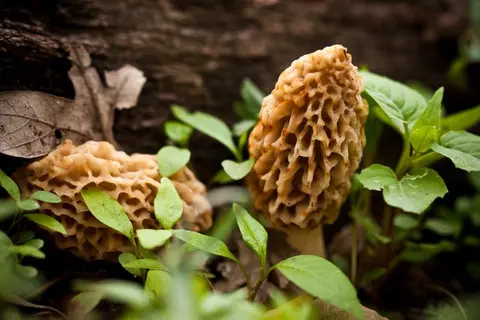
KANSAS CITY, Mo. -- The winter season comes to an end next week and spring begins, which means it's time for morel mushroom hunting season.
You can watch for morel mushrooms growing on the ground, usually beginning in late March into early May. Morels have a short, specific growing season of just several weeks in spring.
According to the Missouri Department of Conservation (MDC), three species are commonly found in our area and will vary in color from gray, tan or yellow and average three to four inches tall.
Missouri Department of Conservation
Morels commonly appear after warm, moist spring weather with daytime temperatures in the low 70s and nighttime temperatures in the 50s, according to MDC.
Morels are typically found under hardwoods and along rivers. The yellow morel, also known as the common morel or sponge mushroom, is the most sought-after wild mushroom in Kansas, according to the Kansas Department of Wildlife Parks & Tourism (KDWP).
The MDC said all species of morels in the state have stems that are completely hollow. Don't confuse true morels with lookalikes that could make you seriously ill or kill you. It's safest to consider all so-called false morels toxic. If you're not 100% positive of the ID, don't eat it.
Wildlife Parks & Tourism
According to the MDC, south and west-facing slopes are good sites to look for morels early in the season, with north and east slopes being better for later-season morel hunting.
Morels tend to favor tree species such as elms, ashes, cottonwoods, and even domesticated apples, according to the MDC. Areas disturbed by flooding, fire, or logging often produce loads of morels.
The MDC said morels have also been found growing in all sorts of locations and conditions.
MDC Areas
So, where are some good places to go mushroom hunting in Kansas and Missouri? Well, the main thing to know is it's serious business, and many mushroom hunters refuse to reveal their morel spots even to close friends and family.
Morels can often be found in forests under logs or near trees, often first on the southern side due to soil temperature changes. The mushrooms are commonly found near certain trees, such as sycamore, hickory, ash, elm and apple trees.
Moist environments near water bodies like rivers, creeks, or ponds are ideal, and areas with recent burns or disturbances are also key locations for morel growth.
Kansas and Missouri?
Here are some tips from KDWP for legal and safe mushroom hunting.
Moist environments near water bodies like rivers, creeks, or ponds are ideal, and areas with recent burns or disturbances are also key locations for morel growth.
Putting it in context
Wild and seasonal foods reward anyone who buys little and often, since the difference between a good week and a great one is usually measured in days.
At a glance
- KANSAS CITY, Mo. -- The winter season comes to an end next week and spring begins, which means it's time for morel mushroom hunting season
- According to the Missouri Department of Conservation (MDC), three species are commonly found in our area and will vary in color from gray, tan or yellow and average three to four inches tall
- Morels are typically found under hardwoods and along rivers
- The MDC said all species of morels in the state have stems that are completely hollow
- According to the MDC, south and west-facing slopes are good sites to look for morels early in the season, with north and east slopes being better for later-season morel hunting
The questions it raises
What should you know about Missouri Department of Conservation?
According to the Missouri Department of Conservation (MDC), three species are commonly found in our area and will vary in color from gray, tan or yellow and average three to four inches tall.
Why does it matter?
KANSAS CITY, Mo. -- The winter season comes to an end next week and spring begins, which means it's time for morel mushroom hunting season.
In short
The details will firm up over the coming months. What is already clear is that this is unlikely to be the last we hear of it.