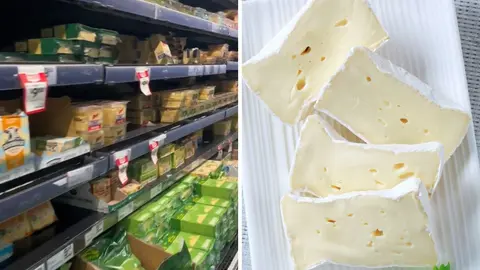
A little-known fact about Australian cheese has left the country reeling after it was exposed by a French tourist.
Leo Filipetti, a comedian currently living in Melbourne, recently claimed he was "shocked" to discover two of France's most famous fromages, brie and camembert, taste "exactly the same" in Australia.
And despite the shock among Aussies, many of whom argued Mr Filipetti had his local cheese knowledge all wrong, it turns out there is some truth to his bold declaration.
"Brie comes from an area north of Paris in France in and around Meaux, while Camembert comes from Normandie (the pointy bit that sticks out into the Atlantic), so in that respect, Australia doesn't make brie nor camembert," Paul Wilson, Chair of Australian Specialist Cheesemakers Association (ASCA), told news.com.au.
However Mr Wilson explained that cheese manufacturers in Australia do follow the same processes, and are able to label the locally made versions with the recognisable French names.
"The cheesemaking technology used to make both brie and camembert is broadly the same," he said.
Australian Specialist Cheesemakers Association
"They are both 'bloomy surface ripened soft cheeses'. The cheesemaking cultures are added to the milk, curd is set, cut, drained, and put into round hoops.
"Traditionally brie goes into big hoops and cams go into small hoops. Over the next 7-10 days the white moulds start to grow on the surface of the cheese which over the next few weeks start to change the inside of the cheese from the firm curd to the gooey and runny 'paste' that we love to spread on bread and crackers."
Where the similarities in their taste come from lies in who is manufacturing it and the flavour preferences of the average Australian consumer, said Mr Wilson.
"Unfortunately the terms 'brie' and 'Camembert' have become lodged in the consumer's mind.
"Consumers have favourites and their opinions so cheesemakers have to work within those marketing constraints.
"Generally, the big industrial cheesemakers in Australia want to get a low cost product out to the supermarkets (and do it very well) and to them 'brie' or 'camembert' are marketing terms and may be used interchangeably.
Mr Wilson
"This means that at the industrial end of the industry, both in Australia and France, the terms have lost their meaning."
The result is that many of the widely available Australian brie and camembert varieties consumers buy at supermarkets have ended up with a similar flavour profile.
So while Mr Filipetti, who originates from the so-called "cheese capital of the world," wasn't entirely on the mark when he said "brie and camembert are exactly the same cheese" - it's easy to see how he came to that conclusion.
Reaction to his video has come in thick and strong, with many echoing Mr Wilson's expertise in how the cheeses are produced in Australia.
"The Camembert cheese is meant to be eaten ripe. However, the Australian consumer thinks they have gone off. This is why they taste like brie," said one.
"We bought a big wheel of French brie in a box when we were in holidays, we opened it with great enthusiasm and nearly fainted at the smell immediately. Let me tell you, as true blue Aussies, we were not prepared," agreed another.
Australia and France
However, if you're a fan of stronger, more potent brie and camembert varieties, all hope is not lost.
"At the small-batch end in Australia we try to steer away from using those terms. Not only that, but we have taken that style of cheesemaking technology and made it our own," Mr Wilson, who also co-owns a Cheese Therapy - a boutique online store selling handcrafted Australian cheese, explained to news.com.au.
"The concept of a 'Triple Cream' is Australian. We took a bloomy white mould cheese, added extra cream, and made it our own.
"So for example, the Nimbin Valley Dairy 'Tintenbar Triple Cream' doesn't even use the word brie or camembert.
"Harvey Cheese (WA) has their 'OMG Triple Cream' - again it's broadly a camembert/brie technology, but they made it their own.
"There is even a new cheesemaker in Tasmania, (Tasmaniam Cheesery) that adds native pepperberry to their 'brie'. It is a delicious and innovative local twist but the French would no doubt horrified at what we have done to their cheese."
Triple Cream
Others in the comments section of the viral clip, which has amassed almost 200,000 views, shared a similar message.
"There are some good small dairies that do it properly," wrote one.
"You bought the wrong brand, mate!" added another.
to discover two of France's most famous fromages, brie and camembert, taste
Where this fits
Desserts carry an outsized share of a menu's personality, even when they account for a small share of its revenue.
At a glance
- A little-known fact about Australian cheese has left the country reeling after it was exposed by a French tourist
- Leo Filipetti, a comedian currently living in Melbourne, recently claimed he was "shocked" to discover two of France's most famous fromages, brie and camembert, taste "exactly the same" in Australia
- Despite the shock among Aussies, many of whom argued Mr Filipetti had his local cheese knowledge all wrong, it turns out there is some truth to his bold declaration
- "The cheesemaking technology used to make both brie and camembert is broadly the same," he said
- Where the similarities in their taste come from lies in who is manufacturing it and the flavour preferences of the average Australian consumer, said Mr Wilson
What people ask
What should you know about Australian?
A little-known fact about Australian cheese has left the country reeling after it was exposed by a French tourist.
Why does it matter?
"This means that at the industrial end of the industry, both in Australia and France, the terms have lost their meaning.".
In short
The details will firm up over the coming months. What is already clear is that this is unlikely to be the last we hear of it.