
Part of a continuing weekly series on Alaska history by local historian David Reamer. Have a question about Anchorage or Alaska history or an idea for a future article? Go to the form at the bottom of this story.
Restaurant operations make for a stressful life, from cost management to staff maintenance to the more basic requirement of consistent, good cuisine. The relationship with the public looms above those aspects, a typically tenuous bond prone to shifts with and without cause, ever beholden to the passing quirks of time. Put simply, people have opinions about what they eat, perspectives formed more by personal idiosyncrasies than anything objective. Hence, some of the most successful restaurants in Anchorage history de-emphasized food in favor of other products. Some supposed eateries, like the 1940s Chili Parlor, sold sex instead, a somewhat more consistently desired commodity than chili.
Businesses serving as fronts for more illicit concerns date to the earliest days of Anchorage, which was notably established as a dry town before the Alaska Bone Dry Act took effect in 1918. Pool halls and cigar shops were the most common businesses where alcohol, drugs, gambling and paid companionship could be obtained. In 1919, the Popular Grill on Fourth Avenue was shut down after a gambling raid. The most notorious bootleggers of early Anchorage, Jacob "Russian Jack" Marunenko and Ed "Phantom Swede" Olson, not coincidentally spent time running a downtown pool hall and cigar shop, respectively.
In the 1970s, before Gwennie's moved to its current location, that building near the lake end of Spenard Road was home to the Pagoda Restaurant, hence the curved eaves to appear more like a traditional pagoda. There was food downstairs and women upstairs. And fronts remain in Anchorage, a popular subject of speculation. A relatively recent Anchorage Reddit thread on suspected local fronts had 177 comments. But none of these examples were as colorful as the Chili Parlor in late 1940s Anchorage.
While not as ancient as some trades, chili has a long history and similarly lengthy presence in Anchorage. Chili peppers have been consumed for millennia on this continent, and adding them to meaty stews was a logical step toward flavortown. In his 1568 personal narrative on the Spanish conquest of the Aztec Empire, conquistador Bernal Díaz del Castillo noted an incident when the Aztecs killed several Spaniards, butchered their bodies and cooked the remains in a stew spiced with red peppers. This chili was then ceremonially consumed, a ritual of power.
And so, chili was a widespread dish with many regional variations, but its modern popularity more directly traces back to late 19th-century San Antonio, Texas, where chili street stalls proliferated. A San Antonio Chili Stand at the 1893 Columbian Exposition in Chicago introduced it to a national audience. By the dawn of the 20th century, there were chili spots in most Alaska settler towns. There were several such in early Anchorage, establishments specializing in chili and tamales, another food craze of the era.
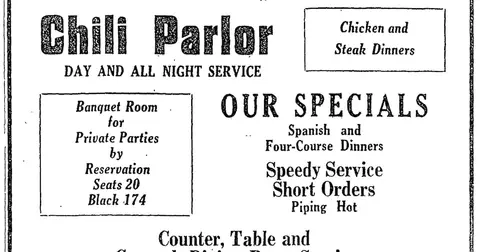
Come the early 1940s, the Chili Parlor on Fifth Avenue, between B and C streets, had been around for a few years when it began to struggle. All glory eventually fades, and so it closed. In the summer of 1943, it reopened under new ownership. For a time, it may have even been a legitimate operation. They briefly advertised, something most fronts don't bother with.
The proprietor was Marie Cox, a mercurial and violent woman. In the words of longtime Alaska lawyer and politician Wendell Kay, she was "alleged to be half Spanish, half Black, and all mean." In 1930, she was convicted of stabbing a man in Juneau with the intent to kill. In 1943, she was on what was at least her fourth husband. Her brushes with the law continued, myriad and varied. She possessed range, from individual acts of violence to vice to theft. Although, witnesses against her had a habit of changing their minds, missing court dates and otherwise disappearing. As it so happens, she was also always able to find outstanding, leading men about town willing to testify on her behalf.
Soon, by 1945 at the latest, the Chili Parlor was also a brothel. The waitresses were the sex workers, plying their other trades in the rooms out back. A white light on the back door beckoned the johns, a lighthouse beacon for the wayward and lonely. Knock, and nobody would answer. There was a code, which seemingly everyone in town knew. Press the buzzer, two long rings and then a short. An evening adventure cost $10 to $20, roughly $140 to $280 in 2026 money. A full night was reportedly $100, or about $1,400 in 2026 money.
The dual nature of the establishment was, at best, one of Anchorage's worst-kept secrets. That May, the Army barred soldiers from the location, as they would be later barred from other notorious businesses and locales about town, such as Eastchester Flats in the 1950s or the Gaslight Bar just last year. The open joke around town was that the side door was the main entrance, while the front door was the "private entrance," the less-used of the two.
For decades, George Grigsby (1874-1962) was one of the most prominent lawyers in Alaska, as well as a former mayor of Nome and, briefly, Alaska's non-voting delegate to Congress. However, his fame, in large part, derived from the questionable quality of his defendants and his shady tactics. Per Pamela Cravez, who has written extensively on Alaska legal history, "It wasn't unusual for evidence to magically appear or disappear at one of Grigsby's trials. Witness stories changed, and his final arguments were always entertaining if not always accurate." And yes, Cox was one of his repeated clients.
In one 1940s case, Grigsby represented the defendant in a knife assault, which just happened to occur at the Chili Parlor. The client stabbed another man in the house of ill repute's backrooms, tore through the back door, and jumped a fence to make his temporary escape. During the trial, Grigsby questioned Cox about that back and was into the weeds on the details, about whether it opened in or out, whether the handle was on the right or left, so on and so forth.
Alaska
As recalled by Wendell Kay, who was there observing with the rest of a jubilant crowd, "Finally Marie's short fuse burned down. Fixing George with an evil glare, she demanded, 'Mr. Grigsby, why are you asking me all these questions about that door? You know that door -- you are in and out of there three or four nights a week!' There were howls of laughter. Pandemonium!"
Kay stated, "I don't know about you, but I might have slunk to the water pitcher. George just stood there, beaming and smiling, until the laughter died out. Then he addressed Marie, 'Ah yes, Mrs. Cox, you and I know all about that door! But your testimony is vital. None of these fine gentlemen on the jury have ever seen that door.' Now there were real howls of laughter. Even the judge was smiling."
In late May 1945, Anchorage District Attorney Raymond Plummer sought to shut the brothel down. Grigsby, representing Cox, declared it impossible to operate both a restaurant and a brothel simultaneously, as both were full-time jobs in Anchorage then. The presiding Judge Anthony Dimond adjourned the proceedings to investigate the premises personally. He saw enough to order the place shut down for a year, with no private occupancy allowed in the back rooms, including Cox and her family.
While the brothel was closed, criminal charges were also brought against Cox. Multiple witnesses, including one of the sex workers, testified on the illicit happenings at the Chili Parlor. Nonetheless, on Jan. 18, 1946, the jury returned a not guilty verdict, perhaps swayed by more of that alleged Grigsby magic. A perturbed Judge Dimond noted the jury claimed a "lack of corroborative evidence," though he stated, "it is evident from testimony that a shameful and abominable crime has been committed."
Time passed, and the Chili Parlor reopened, both the front and back sides. In October 1947, a certain C. J. Chudy had some ill-described beef with Cox. As a result, he smashed out one of the windows at the brothel and agreed to testify on its more salacious practices. Eager to press a case against Cox, the city attorney Ed Arnell rounded up another witness, Ed McGee, and proceeded to trial. Grigsby again represented Cox.
But when the day of the trial arrived, neither witness showed. McGee could not be found at all, not even at work. And Chudy, once so vehemently opposed to Cox, was discovered in bed. Chudy said he was too sick to testify, a claim refuted by his doctor.
Judge William Olsen asked Arnell if he could produce his witnesses the next day. Arnell replied, "I thought I could have them here today, but I didn't. Consequently, I can't promise to have them here tomorrow." Judge Olsen decided to proceed without Chudy and McGee, so Arnell dropped the case. Resplendent in a long fur coat, Cox exited the courthouse with a rare, warm smile.
In January 1948, District Attorney Plummer reinitiated his efforts to close the bawdy house. Cox and four other women were charged with operating a brothel and selling liquor without a license. The other women included Cox's adult daughter, Agnes, who also resided at the Chili Parlor. After a few days, Judge Joseph Kehoe issued a restraining order closing the business for the duration of the trial.
And when that trial began, in late February, it was the comedy hit of the year in Anchorage. There was no movie, play or visiting comedian that could compare. Crowds arrived early, pressed into the courtroom, lines of them all eager for the firsthand tales. At least half of them were women. They alternated quiet -- to hear the testimonies -- and raucous laughter.
Judge Kehoe, on the moments when he himself did not lightly succumb to the merriment, repeatedly admonished the unruly audience. At one point, he sternly ordered, "This is not a picture show. This is not a side show but a court of justice and the dignity of the court must be preserved." It was a noble if vain effort. During the trial, the district attorney introduced a surprise witness, another Chili Parlor sex worker. This woman, Fay Nolan, happened to be a little person. The local mob was not mature about this.
George Kane, a civilian employee at Fort Richardson, was one of the first witnesses. He admitted to visiting "four or five, maybe six times." "Any young man in town knows ... the general reputation," he asserted. Among the women, he had a favorite, Ruby Stewart. As he testified, "Ruby admitted me. We took a stroll. Inside the house, that is."
Plummer asked him, "What did you do the other times?"
District Attorney Raymond Plummer
Kane replied, "Practically the same thing." The crowd roared its appreciation.
His last visit went sideways, leading to his presence as a witness. Maybe, just maybe, a bit inebriated, he and a friend visited that January, but they had some trouble getting in. In their desperation, they ripped the screen on the door. "Finally, a man stepped up and pointed what looked like a .38 at me. He pulled the trigger, and I covered my eyes." The man was Rodney Cox, Marie's husband, and the gun was loaded with tear gas.
Weeks later, Kane was still visibly upset by the incident. "Sure. I was angry," he said. He reiterated, "Sure. I'm still angry." Moreover, "And me a good customer, too." The crowd cheered.
Another customer, Walter Schwartz, testified that he paid $100 to spend an entire night in the backrooms. On one occasion, he stayed there 10 or 11 days. "It took me that long to rest up." As the intelligent reader would guess, the crowd laughed.
Plummer asked Schwartz if any food was ever served at the Chili Parlor. "I have never been able to get even a cup of coffee," said Schwartz, also clearly a good customer.
Jennie Pinkston was an older woman, hired as something like a housekeeper at the Chili Parlor. She spent about a month there but wasn't paid, so she lacked any loyalty to Cox. She testified, "The first night I was there, I knew something was wrong." Even the contemporary sources note, "The crowd chortled."
As Pinkston described the Chili Parlor, the food was a distant afterthought. If customers were that determined for literal chili, they sometimes opened a can. Per her, the sex workers paid Cox $15 for their room and board.
When Cox took the stand, she was dressed to impress, with a silk blouse, oversized hat, and golden hoop earrings the size of half dollars. Given ample room by both Grigsby and Plummer to soliloquize, she spent three hours talking. She denounced every other witness, denied every illegal act, and countered every claim. To hear her say it, she had never seen Fay Nolan before. They indeed served food, good food, allegedly. No one had sex at the Chili Parlor, let alone for money.
Except she did gleefully admit to her husband shooting Kane in the face with the tear gas. She happily painted a picture of a wounded Kane. "He jumped like a rabbit, and then flopped on his knees," she declared to the always amused crowd.
Despite the numerous testimonies regarding the true nature of the Chili Parlor, from patrons and sex workers alike, some surprisingly respected individuals came to the establishment's defense. That same Judge William Olsen from before appeared and testified that he had enjoyed a fine steak dinner at the restaurant and had even visited on multiple occasions without noticing anything amiss. In other words, he visited and admitted to enjoying an establishment that had been repeatedly charged as being a bawdy house, even in his own court.
At one point, Plummer had to take the stand to identify a defendant due to discrepancies in her name. Under cross-examination, he also admitted to visiting the Chili Parlor as well. "They have good meals there, didn't they?" smirked Grigsby.
The jury deliberated for a long eight hours but returned with a guilty verdict. Four of the five women, excluding Marie Cox, were fined $250 each, roughly $3,500 in 2026 money. Cox was sentenced to six months in prison.
Chili Parlor
Cox did not go gently into that good night. For all the drama, the brothel charge was neither her only outstanding legal issue nor would it be the most damning. After the trial, she claimed that William Green, who held the lease on the Chili Parlor, threatened her with a gun. Though Green was arrested, the charge was dismissed when Cox did not appear in court. She was also charged with not paying a different employee than any of the others previously mentioned, and she vandalized a car, because why not.
In early 1949, she petitioned to reopen the Chili Parlor. Persistence is an entrepreneurial virtue after all. Yet, she did not have the opportunity. That February, she was arrested for buying stolen government property, diesel fuel from Fort Richardson. Soldiers in on the scam used an Army tanker to fill the underground tank at the erstwhile Chili Parlor. She was sentenced to 18 months in prison.
The nine-day trial was more embarrassing for Cox than her previous appearances. The soldiers, given previous good records, received only suspended sentences and testified freely. Not only had Cox committed a crime for which she was caught, but the soldiers also conned her. The truck contained about 200 to 250 gallons of fuel, but they told Cox it was 600 gallons' worth. "I told her 600," said one of the soldiers, "but when I found out she had an underground tank, I thought she would never know the difference." As a result, she paid 40 cents a gallon when the going rate was 17 cents.
To quote "The Second Coming" by William Butler Yeats, "The best lack all conviction, while the worst are full of passionate intensity." The lessons learned are thus: The past was at least as ribald as the present; there is no telling what lurks behind closed doors in Anchorage; and beware of Anchorage residents offering "chili."
Key sources:"5 Women Named in Complaint." Anchorage Daily Times. January 13, 1948, 8.
"Chili Parlor a Restaurant, Court Hears." Anchorage Daily Times. March 3, 1948, 1.
"Chili Parlor Reopens." Anchorage Daily Times. July 3, 1943, 8.
"City Witnesses Fail to Appear; Case Dismissed." Anchorage Daily Times. October 14, 1947, 3.
"Con Evidence in Cox Case." Anchorage Daily Times. January 18, 1946, 8.
"Court Abates Chili Parlor." Anchorage Daily Times. June 12, 1945, 8.
Cravez, Pamela. "State Needs Its Seniors; Seniors Need Longevity Bonus." Anchorage Daily News. February 10, 1993, B12.
Daily Times January
"Crowds Attend Bawdy House Court Hearing." Anchorage Daily Times. February 27, 1948, 8.
"Defacing Property Costs Man $15." Anchorage Daily Times. January 14, 1948, 6.
Díaz del Castillo, Bernal. The Conquest of New Spain. Harmondsworth, England: Penguin Books, 1973.
"Five Men Arrested in Gambling Raid." Anchorage Daily Times. April 12, 1919, 6.
Kay, Wendell. "Kay Tells Tales on Alaska." Alaska Bar Rag. April 1985, 1, 6, 8, 10.
"Marie Cox' Sentence Set at Six Months." Anchorage Daily Times. March 15, 1948, 3.
"Marie Cox Takes Stand in Court Trial." Anchorage Daily Times. March 2, 1948, 1.
"Pays Stiff Price for Oil from Post." Anchorage Daily News. June 10, 1949, 1, 2.
"Prosecution Finishes Case." Anchorage Daily Times. February 28, 1948, 1, 3.
"Side Doors, Sidelines." Anchorage Daily Times. June 7, 1945, 1.
alleged to be half Spanish, half Black, and all mean.
Key takeaways
- Restaurant operations make for a stressful life, from cost management to staff maintenance to the more basic requirement of consistent, good cuisine
- In the 1970s, before Gwennie's moved to its current location, that building near the lake end of Spenard Road was home to the Pagoda Restaurant, hence the curved eaves to appear more like a traditional pagoda
- While not as ancient as some trades, chili has a long history and similarly lengthy presence in Anchorage
All told
Every change in the food industry eventually reaches the same test, which is whether people keep choosing it once the novelty has worn off.