
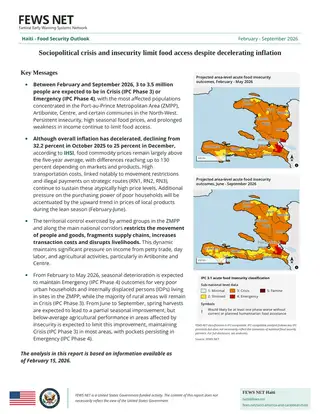
* Between February and September 2026, 3 to 3.5 million people are expected to be in Crisis (IPC Phase 3) or Emergency (IPC Phase 4), with the most affected populations concentrated in the Port-au-Prince Metropolitan Area (ZMPP), Artibonite, Centre, and certain communes in the North-West. Persistent insecurity, high seasonal food prices, and prolonged weakness in income continue to limit food access.
* Although overall inflation has decelerated, declining from 32.2 percent in October 2025 to 25 percent in December, according to IHSI, food commodity prices remain largely above the five-year average, with differences reaching up to 130 percent depending on markets and products. High transportation costs, linked notably to movement restrictions and illegal payments on strategic routes (RN1, RN2, RN3), continue to sustain these atypically high price levels. Additional pressure on the purchasing power of poor households will be accentuated by the upward trend in prices of local products during the lean season (February-June).
* The territorial control exercised by armed groups in the ZMPP and along the main national corridors restricts the movement of people and goods, fragments supply chains, increases transaction costs and disrupts livelihoods. This dynamic maintains significant pressure on income from petty trade, day labor, and agricultural activities, particularly in Artibonite and Centre.
* From February to May 2026, seasonal deterioration is expected to maintain Emergency (IPC Phase 4) outcomes for very poor urban households and internally displaced persons (IDPs) living in sites in the ZMPP, while the majority of rural areas will remain in Crisis (IPC Phase 3). From June to September, spring harvests are expected to lead to a partial seasonal improvement, but below-average agricultural performance in areas affected by insecurity is expected to limit this improvement, maintaining Crisis (IPC Phase 3) in most areas, with pockets persisting in Emergency (IPC Phase 4).