There is a moment that happens to almost every first-time visitor to Sicily. You are standing at a street stall in Palermo, holding something golden and crispy and impossibly warm, and you take a bite -- and you realize that Italian food, the food you thought you knew, was never really the whole story.
Sicily is not Italy. Not quite. It sits at the crossroads of the Mediterranean, an island that has been ruled by Greeks, Arabs, Normans, Spanish, and finally Italians -- and every single one of them left something behind in the kitchen.
The Arab kitchen that changed everything
The most surprising chapter in Sicilian food history is the Arab period, between the 9th and 11th centuries. The island's Arab rulers introduced sugarcane, citrus, almonds, saffron, raisins, and pine nuts -- ingredients that seem ordinary now but were transformative at the time. They also brought a philosophy of combining sweet and savory in ways that the rest of Europe wouldn't fully embrace for centuries.
You can taste this legacy directly in caponata -- the island's famous sweet-and-sour eggplant relish, built on vinegar and sugar -- and in pasta con le sarde, a dish of sardines and fennel made extraordinary by the addition of raisins and pine nuts. These are not Italian flavors. They are Sicilian flavors, and the distinction matters.
Street food as time travel
Greeks Arabs Normans Spanish
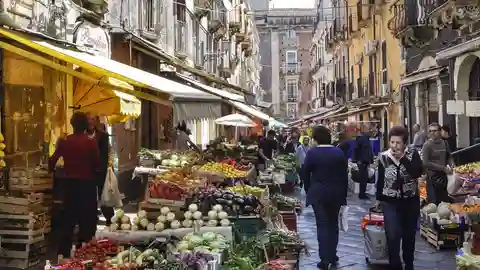
If you ever find yourself in Palermo, skip the restaurant for your first meal. Head to the Ballarò market instead.
The street food of Palermo is one of the great culinary experiences in the world. Arancini -- saffron-scented rice balls stuffed with meat ragù and fried until deeply golden -- are passed between hands still warm from the fryer. Panelle, soft chickpea fritters, are tucked into sesame rolls and eaten standing up. The whole thing feels ancient, because it is.
These dishes have been eaten in these streets, in roughly this form, for close to a thousand years.
The table as the whole point
Away from the markets, Sicilian home cooking is slower and more deliberate. Sunday lunch is not a meal -- it is an event. A stuffed beef roll called falsomagro might braise for two and a half hours. Pasta al forno, a baked pasta layered with ragù, hard-boiled eggs, salami, and melting cheese, comes out of the oven in a dish large enough to feed everyone at the table twice.
Sicily
This is food built around the idea that the table is the whole point. That the hours spent cooking are not separate from the hours spent together -- they are the same thing.
What the desserts tell you
Sicilian desserts are where the island's history becomes sweetest and most literal. Cassata -- layers of sponge cake, sweetened ricotta, and candied fruit under a brilliant green marzipan shell -- is a direct descendant of Arab confectionery. Cannoli, with their crispy fried shells and cloud-like ricotta filling, have been made in Sicily since at least the medieval period.
And granita -- eaten for breakfast with a warm brioche bun, in flavors of lemon or almond or mulberry -- is simply the best possible argument for booking a flight to Catania.
You can cook your way there
The honest truth is that Sicily is one of the more difficult Italian destinations to reach. Flights connect through Rome or Milan, ferries take time, and the island rewards slow travel more than a quick weekend.
Why people are talking about it
But the food travels beautifully.The ingredients are simple. The techniques are learnable. And the flavors -- that particular combination of sweet, salty, sour, and deeply savory that defines Sicilian cooking -- are unlike anything else you will find in a European kitchen.
A new eBook by Maria Conti -- La Cucina di Casa: Traditional Sicilian Home Cooking -- collects exactly this kind of food: the recipes cooked in family kitchens rather than restaurants. It covers everything from caponata and arancini to falsomagro, cannoli, and cassata. 30 authentic recipes, organized by course, with a cultural note for each dish.
If Sicily is on your list, consider cooking your way there first.
Traditional Sicilian Home Cooking
Disclosure: This article contains an affiliate link. If you purchase through it I may earn a small commission at no extra cost to you.
granita -- eaten for breakfast with a warm brioche bun, in flavors of lemon or almond or mulberry -- is simply the best possible argument for booking a flight to Catania.
Reading the wider picture
Retail decisions rarely happen all at once. What looks like a sudden change of direction is usually the visible end of months of testing, costing and quiet negotiation behind the scenes.
Key takeaways
- The most surprising chapter in Sicilian food history is the Arab period, between the 9th and 11th centuries
- The street food of Palermo is one of the great culinary experiences in the world
- Away from the markets, Sicilian home cooking is slower and more deliberate
- Sicilian desserts are where the island's history becomes sweetest and most literal
- Granita -- eaten for breakfast with a warm brioche bun, in flavors of lemon or almond or mulberry -- is simply the best possible argument for booking a flight to Catania
What people ask
What should you know about Sicily?
Cannoli, with their crispy fried shells and cloud-like ricotta filling, have been made in Sicily since at least the medieval period.
What happens next?
the flavors -- that particular combination of sweet, salty, sour, and deeply savory that defines Sicilian cooking -- are unlike anything else you will find in a European kitchen.
The bottom line
None of this settles the wider question. It does make one thing harder to ignore: the pressure in the food industry has shifted, and others will have to respond to it.