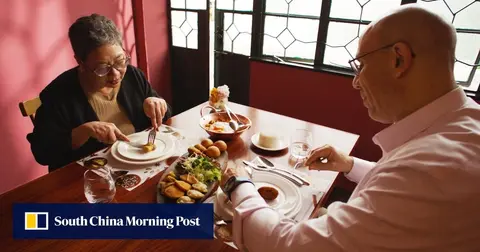
"If you ask a Macanese who makes the best minchi, they always say mine, or my mother's, or my grandmother's," Marina de Senna Fernandes, a Macanese chef, says.
The locals' unflinching devotion to this much-loved local comfort food - made from stir-fried minced meat and served with potatoes, rice and fried egg - offers a glimpse into why Macanese cuisine holds such a significant place in the city's history.
As a former Portuguese colony, Macau was one of the important ports along the Portuguese spice trading route, which brought people and different foods and ingredients from across Africa, India, Southeast Asia and beyond to the city. This melting pot gave birth to its unique cuisine, which was deemed the world's first "fusion food" by Unesco and recognised as part of Macau's intangible cultural heritage.
Marina de Senna Fernandes
De Senna Fernandes helps run a non-profit canteen that showcases Macanese food at the Macanese Association, and she met Ahmed Abdel Fattah, a lecturer at Macau University of Tourism, to talk about the importance of preserving Macau's culinary heritage.
"Food has to do with identity, and our identity is very complex," de Senna Fernandes says. "For instance, in my family, my ancestors were Portuguese, Chinese, Indian - some even from other countries. There are other families that have Spanish blood, or Peruvian or Chilean. So all these people came together, isn't that amazing?
"They came together in one place, and they settled and they started sharing their food from their country. Little by little, what they cooked became a cuisine."
Macau University of Tourism
Abdel Fattah, who was born in Egypt and lived in many countries, including the United States, Australia and France, moved to Macau and started teaching at the Macau University of Tourism in 2013. His main focus at work is heritage tourism management.
If you ask a Macanese who makes the best minchi, they always say mine, or my mother's, or my grandmother's.
Reading the wider picture
Costs, supply and public patience all move at different speeds, and the friction between them is where most food-industry stories actually begin.
What to remember
- "If you ask a Macanese who makes the best minchi, they always say mine, or my mother's, or my grandmother's," Marina de Senna Fernandes, a Macanese chef, says
- As a former Portuguese colony, Macau was one of the important ports along the Portuguese spice trading route
- De Senna Fernandes helps run a non-profit canteen that showcases Macanese food at the Macanese Association
- "Food has to do with identity, and our identity is very complex," de Senna Fernandes says
- Abdel Fattah, who was born in Egypt and lived in many countries, including the United States, Australia and France, moved to Macau and started teaching at the Macau University of Tourism in 2013
What people ask
What should you know about Macau University of Tourism?
De Senna Fernandes helps run a non-profit canteen that showcases Macanese food at the Macanese Association, and she met Ahmed Abdel Fattah, a lecturer at Macau University of Tourism, to talk about the importance of preserving Macau's culinary heritage.
Why does it matter?
The locals' unflinching devotion to this much-loved local comfort food - made from stir-fried minced meat and served with potatoes, rice and fried egg - offers a glimpse into why Macanese cuisine holds such a significant place in the city's history.
All told
Every change in the food industry eventually reaches the same test, which is whether people keep choosing it once the novelty has worn off.