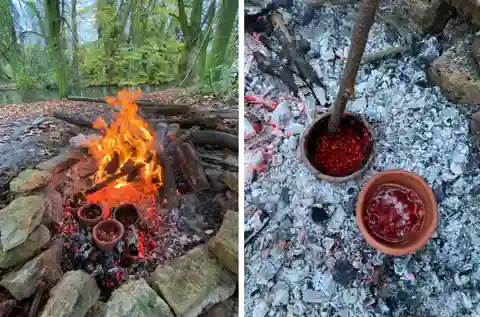
Imagine yourself on the banks of a river in Eastern Europe 7,000 years ago. You're contemplating dinner and what could go on the plate (or rather, in the bowl). What are you eating?
Your first response would likely be "whatever we hunted yesterday or today." Or if you don't have any meat, then maybe whatever plants happen to be in season on that day. But the real response is much more complex. Not only did Stone Age people use a complex mix of foods, but they seemed to follow recipes passed down through generations. Sometimes, they used striking combinations.
The new study used high-powered microscopes to look at the charred, crusty gunk stuck to the inside of 8,000 year-old ceramic shards.
Archaeologists have traditionally relied on "lipid residue analysis" to figure out what was in a pot. This involves soaking a piece of pottery in solvent to pull out ancient fats. It's a great technique, but it has a massive bias: it loves animal fat. Plants don't have nearly as much fat as a fatty salmon or a piece of suet, so their chemical signature gets drowned out.
Eastern Europe
The archaeological record is already biased towards animal products. While animals leave behind hard bones that can survive for millennia, plants rot and disappear. The only way they can be conserved for archaeologists is if they are burned to a crisp.
So, that's what the authors of the new study looked at. The team, led by Lara González Carretero from the University of York, examined organic remains found in 58 pieces of pottery uncovered at 13 archaeological sites across Northern and Eastern Europe dating between the 6th and 3rd millennium BC.
This method recovered tissue samples of a wide variety of plants, including grasses, berries, leaves, and seeds. In many cases, plant remains were found alongside those of animals, most often fish and other seafood. The exact mixtures and ingredients varied from region to region, most likely reflecting which resources were locally available. But there was also a striking cultural side to things.
The most startling discovery wasn't just that they ate plants, but how they combined them. Different cultures seemed to make their own "signature dishes."
Northern and Eastern Europe
Take the site of Dąbki in Poland or Zamostje 2 in Russia. There, the researchers found a very specific combination: Guelder rose berries (Viburnum opulus) mixed with freshwater fish.
Viburnum berries are bitter and mildly toxic if consumed raw. They also release a strong pungent smell during cooking. Yet, when they get cooked with the fats from fish, they become more palatable. At Dąbki, these berries don't appear among the general plant remains of the site. They only show up inside the pots. This suggests they were only cooked alongside fish. It's a prehistoric "specialty of the house."
Further south, in the Don River basin, the menu changed. There, the "chefs" were obsessed with seeds. The foodcrusts were packed with wild grasses and wild legumes, like clover, all cooked together with (you guessed it) more fish.
In the Baltic region, the researchers found evidence of "green vegetables." They identified the stems, leaves, and flowers of the Amaranthaceae family, which includes things like wild beet and goosefoot. At the site of Syltholm II in Denmark, they even found "sea beet" roots and tubers from sea club-rush. These were often mixed with fish and, surprisingly, dairy products likely traded from nearby farming communities.
Don River
This regional variation is a big deal. It shows that food was about more than just calories; it was about culture. Even when two groups had access to the same plants, they chose to use them differently. Basically, the way you made your stew was a way of saying who you were.
The study also says something about the invention of these bowls themselves. Some scientists claimed they were mostly used for processing foods or simply for storage. This study clearly indicates the bowls were also used for eating.
Before pots, you could roast meat over a fire or pit-roast tubers in the ground. But a pot allows for boiling. It lets you combine liquids, fats, and solids into a single, cohesive dish. It lets you create "new aesthetics, tastes, flavors, and textures" that were impossible before. Bowls allow you to cook food in the way you want, rather than just putting calories in your body. It made food more digestible and, frankly, more delicious.
This type of "detective" work is what modern archaeology is all about. By looking at the microscopic "fingerprints" of a leaf or the "bran" of a wild grass seed, we can reconstruct a meal that hasn't been served for 7,000 years. With this, we can understand ancient people better than ever before.
whatever we hunted yesterday or today.
Where this fits
Costs, supply and public patience all move at different speeds, and the friction between them is where most food-industry stories actually begin.
What to remember
- Your first response would likely be "whatever we hunted yesterday or today." Or if you don't have any meat, then maybe whatever plants happen to be in season on that day
- The new study used high-powered microscopes to look at the charred, crusty gunk stuck to the inside of 8,000 year-old ceramic shards
- Archaeologists have traditionally relied on "lipid residue analysis" to figure out what was in a pot
- The archaeological record is already biased towards animal products
- Take the site of Dąbki in Poland or Zamostje 2 in Russia
By the numbers
- Imagine yourself on the banks of a river in Eastern Europe 7,000 years ago
- By looking at the microscopic "fingerprints" of a leaf or the "bran" of a wild grass seed, we can reconstruct a meal that hasn't been served for 7,000 years
All told
Every change in the food industry eventually reaches the same test, which is whether people keep choosing it once the novelty has worn off.