Aph Ko got tired of hearing that eating vegan was something only white people did. So in 2015, she created a list of 100 black vegans for a website. It included pioneering figures like Dick Gregory and Coretta Scott King and younger, less famous writers, filmmakers, cooks and activists.
"When you say 'vegan,' a lot of people tend to only think of PETA, which doesn't reflect the massive landscape of vegan activism," said Ko, 28, a Floridian whose favorite dish at the moment is the spinach pie in "The Vegan Stoner Cookbook." "The black vegan movement is one of the most diverse, decolonial, complex and creative movements."
So many other people wanted to be included on the list after it appeared, she started a website, Black Vegans Rock. That spawned a Twitter hashtag (#blackvegansrock) and a T-shirt business. In June, she published "Aphro-ism: Essays on Pop Culture, Feminism, and Black Veganism from Two Sisters," a book she wrote with her older sister, Syl Ko.
Vegan cooking and eating are having a renaissance among black Americans, driven in part by movements like Black Lives Matter, documentaries like "What the Health," and a growing cadre of people who connect personal health, animal welfare and social justice with the fight for racial equality. Athletes like Kyrie Irving of the Boston Celtics and pop stars like singer Jhené Aiko are bringing a certain pop culture cachet. Cookbook authors and a new breed of vegan soul food restaurants offer culinary muscle.
"I no longer feel like an endangered species out here," said Zachary Toliver, 26, a writer in Tacoma, Washington, who was on the 100 Black Vegans list and is now a columnist for PETA, the animal rights group, where he writes articles like "Here Are 11 Things You Can Expect to Happen if You're Vegan While Black." (No. 1: "You're still just as nervous about whether or not your white friends properly seasoned the food.")
Like many food trends that seem new, black veganism has historical roots. Eating vegan has long been a practice, especially for followers of religious and spiritual movements like Rastafarianism and the African Hebrew Israelites of Jerusalem, a religious group with black nationalist underpinnings that rose up in the 1960s and still runs a chain of vegan restaurants in cities like Atlanta; Tallahassee, Florida, and Tel Aviv.
Avoiding meat is also a core principle of the Nation of Islam, whose founders believed that pork was at the heart of the slave diet, and preached vegetarianism as the most healthful diet for African-Americans.
Many people who give up eating animal products do it for their health, or for animal welfare. The same is true for the new veganism among African-Americans, but there is an added layer of another kind of politics.
"It's not just about I want to eat well so I can live long and be skinny," said Jenné Claiborne, a personal chef and cooking teacher who recently moved to Los Angeles from New York. Her first cookbook, "Sweet Potato Soul," is due out in February. "For a lot of black people, it's also the social justice and food access. The food we have been eating for decades and decades and has been killing us."
Claiborne, 30, is part of a new generation of vegan cooks who are transforming traditional soul food dishes, digging deeper into the West African roots of Southern cooking and infusing new recipes with the tastes of the Caribbean.
As a result, ideas about the dull vegan stews and stir-fries that were standard-bearers among the early generations of black vegan cooks are changing -- albeit slowly.
"Some folks are kind of stuck in the '70s," said Jessica B. Harris, 69, an author and a food scholar of the African diaspora. "Their food seems to come with a dashiki. And don't tell me it's like fried chicken when it's tofu."
Bryant Terry cooks to counter the old ideas about vegan food. The chef-in-residence at the Museum of the African Diaspora in San Francisco, Terry, 43, wrote "Afro-Vegan: Farm-Fresh African, Caribbean and Southern Flavors Remixed," a 2014 cookbook that regularly makes it to the top 10 soul food cookbook rankings on Amazon.
His recipe for millet cakes is bright with the brick-red Ethiopian spice blend berbere. He likes to serve it with a sauce built from roasted green peppers, garlic and cilantro, and infused with heat from jalapeños.
"In some ways, it's a quiet wink to the '70s-style macrobiotic veggie burgers," he said. But it pales in comparison to what a new batch of black vegan cooks are doing. "I cook like someone's grandma," he added. "What I'm really excited about are some of the younger chefs who are professionally trained and know how to put food together in a new way."
One of them is Claiborne, who grew up in suburban Atlanta and moved to New York after college to pursue an acting career. Her father was raised vegan, according to Hebrew Israelite beliefs, and still eats that way 90 percent of the time, she said. She grew up eating everything but red meat, and learned to cook soul food at her grandmother's side.
Feminism and Black Veganism
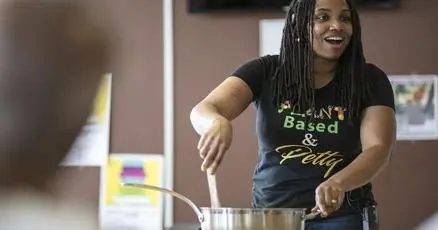
Claiborne wasn't a vegan when she started a food blog in 2010 as a way to pass the time between auditions. That came a year later, when she got a job at Peacefood Cafe in Manhattan. Now she dedicates herself to countering the notion that soul food has to include meat, and that childhood classics need milk or butter.
She adds butternut squash to sweet potato pie to create the texture usually contributed by eggs. Oyster mushrooms stand in for shrimp in Creole étouffée. She puts jackfruit in her jambalaya and cooks down collard greens with soy sauce and smoked paprika instead of pork.
Health is often not enough of a reason for people to give up meat, she said. The challenges that come with being black in America can be. "When it's bigger than you, and it's political and it's spiritual, that is an entrance point for people," she said.
The toughest cultural touchstone to let go of is fried chicken, she said. "People tell me: 'I can't do without the chicken. I'd rather die a painful death than have to give up chicken,'" she said. To help, she created spicy chicken-fried cauliflower, in which she builds a crunchy crust by dipping large florets into seasoned flour and then a batter of hot sauce, Dijon mustard and soy milk.
Popular culture is also shining a new light on black veganism and bringing more converts. Some trace the boost to the late 2000s, when two key books were published: A. Breeze Harper's anthology titled "Sistah Vegan: Black Female Vegans Speak on Food, Identity, Health, and Society" and Tracye McQuirte's "By Any Greens Necessary: A Revolutionary Guide for Black Women Who Want to Eat Great, Get Healthy, Lose Weight, and Look Phat."
Then came Oprah Winfrey, who challenged her staff to go vegan for a week in 2011 and built a show around it. In 2015, Jay-Z and Beyoncé became partners in a vegan meal kit service.
Celebrities continue to join in. Laverne Cox and Danielle Brooks, stars of "Orange Is the New Black," said recently that they were going vegan. And in the current season of "The Real Housewives of Atlanta," a cast member, Porsha Williams, announced she was a "baby vegan."
African-American sports stars have embraced vegan diets as a way to improve their performance. Serena and Venus Williams say they try to eat vegan most of the time. Former NFL linebacker David Carter (nicknamed the 300-Pound Vegan) stopped eating animal products a few years ago.
In an article this month on Bleacher Report, Kip Andersen, the director of the documentary "What the Health," was quoted as saying that so many professional basketball players had given up meat that the league might soon be called the NVA -- the National Vegan Association.
Hip-hop artists have embraced veganism as part of a larger effort to improve the health of their fans. Last year, the Atlanta based rapper who goes by the name Grey had a minor internet hit with a vegan Thanksgiving rap. And in April, several vegan-friendly performers gathered at the Schomburg Center in Harlem to formally introduce health and wellness as "the 10th element of hip-hop." (Although there is some debate over what that list should be, the other nine on that list are breaking, emceeing, graffiti art, DJing, beatboxing, street fashion, language, knowledge and entrepreneurialism.)
The event was part of Hip Hop Is Green, a health initiative started by Keith Tucker of Seattle that produces dinners and concerts that promote plant-based eating.
Tassili Ma'at, 60, owns Tassili's Raw Reality in the historic West End of Atlanta. She raised her youngest two children as vegans, and now eats only raw food. She's a member of the Atlanta chapter of Hip Hop Is Green, which she says is a way to help young people identify veganism as both "something cool and something political."
"I acknowledge my customers for being modern-day revolutionaries without picking up a gun or having to throw a grenade or pick up a picket sign and carry it down the street," she said. "We are defying the death industry."
Then again, sometimes it's just about eating something delicious and having fun. To that end, cooks in several cities have begun hosting black-focused vegan food festivals and "mac downs," where hundreds of people compete in vegan mac-and-cheese competitions.
In Baltimore in August, the Vegan SoulFest attracted nearly 10,000 people, said Naijha Wright-Brown, 45, who opened the vegan soul food bistro The Land of Kush in 2011 with her husband, Greg Brown, and owns five "Black Vegans Rock" T-shirts.
Theirs is one of dozens of new black-owned vegan restaurants that have popped up recently in cities like Los Angeles, Detroit and New York.
Hip Hop Is Green
"You can't say all vegans have to support animal welfare or social justice," Wright-Brown said. "We aren't going to beat you in the head. This is about having compassion. We just want people to eat some vegan soul food and have some fun."
-- Recipes:Oyster Mushroom Étouffée
Yield: 4 servings
Time: About 45 minutes
Ingredients:3 tablespoons grapeseed or coconut oil
3 tablespoons all-purpose flour
1 small yellow onion, diced
2 garlic cloves, minced
1 small green bell pepper, diced
2 celery stalks, diced (about 1 cup)1/2 teaspoon salt
1 cup diced tomatoes, canned or fresh
2 1/2 cups vegetable stock or water (if using water, add 1 vegetable bouillon cube)
1 dried bay leaf
1 teaspoon dulse (seaweed) flakes
1 tablespoon Creole seasoning or 1 teaspoon each black pepper, paprika and dried thyme
1 tablespoon Old Bay seasoning, more to taste
1 pound fresh oyster mushrooms, trimmed and roughly chopped (about 2 cups)
Freshly cooked brown rice, for serving
Lemon wedges, for serving
1/2 cup chopped fresh parsley, for serving
Preparation:1. In a large Dutch oven or heavy pot, heat the oil over medium heat until it ripples, then sprinkle in the flour. (Test the oil by dropping a pinch of flour into the pot. If it sizzles, it is hot enough). Stirring constantly, cook flour and oil together until the mixture toasts and turns golden brown, 2 to 3 minutes.
2. Add onion, garlic, bell pepper, celery and salt and stir. Cook, stirring, over medium heat until the onion is translucent, about 3 minutes. Add tomatoes, stock, bay leaf, dulse, Creole seasoning, and Old Bay. Stir well and bring the pot to a simmer. Add mushrooms and simmer, stirring occasionally, until tender, about 20 minutes. Taste and adjust the seasonings with salt and Old Bay.
3. Serve étouffée spooned over rice, garnished with lemon and parsley.
--Mall-Style Vegetable Stir-Fr
Yield: 4 servings
Time: 35 minutes Ingredients: For the sauce:1 teaspoon grapeseed oil
1 1/2 tablespoons minced fresh ginger
2 garlic cloves, minced
Old Bay Stir
1/2 cup soy sauce3 tablespoons rice vinegar
1 teaspoon toasted sesame oil
6 medjool or other dried dates, pitted and chopped
1 tablespoon arrowroot powder or cornstarch
For the stir-fry:1 tablespoon grapeseed or coconut oil
1/2 cup thinly sliced red onion, or 2 shallots, thinly sliced
1 red bell pepper, chopped or julienned
1 carrot, chopped or julienned
1 head broccoli, cut into bite-sized florets and pieces
1 1/2 cups cooked chickpeas (1 15-ounce can, drained and rinsed)
Freshly cooked brown rice, for serving
1 tablespoon sesame seeds (raw or toasted)
1 to 2 fresh limes, quartered
1/4 cup chopped fresh cilantro
Preparation:1. Make the sauce: In a saucepan, heat oil over medium heat. Add ginger and garlic, and cook, stirring, just until garlic starts to turn golden, about 1 minute. Stir in soy sauce, rice vinegar, sesame oil and dates. Let simmer 5 minutes.
2. Meanwhile, whisk arrowroot with 1/3 cup water until smooth. Slowly stir the mixture into the simmering sauce. When sauce begins to thicken (this will happen very quickly), remove from heat and set aside to cool.
3. When cool enough to handle, transfer sauce to a blender, and blend until smooth.
4. Make the stir-fry: In a wok or skillet with a lid, heat oil over medium heat. When hot, add onions. Stir-fry about 1 minute, until softened. Add red pepper and carrots, cover and cook 5 minutes, stirring occasionally. Stir in broccoli, chickpeas and sauce, and cook, covered, stirring occasionally, until vegetables are cooked to your liking, about 10 minutes.
5. Serve over rice, garnished with sesame seeds, fresh cilantro and lime wedges.
--Millet Cakes With Smoky-Spicy Green Sauce
Yield: 4 servings
Ingredients: For the sauce:1 dried medjool date, pitted
2 tablespoons extra-virgin olive oil
1 teaspoon minced fresh ginger
2 large garlic cloves, minced
Fine sea salt
4 green bell peppers, roasted, peeled and seeded (see note)
1 large jalapeño, roasted, peeled and seeded (see note)
1/4 cup minced cilantro
1 teaspoon bourbon
Freshly ground white pepper
For the cakes:2 tablespoons powdered flaxseeds
1 medium russet potato, scrubbed
1/2 cup millet, rinsedFine sea salt
1/2 cup red lentils, sorted and rinsed
2 tablespoons peanut or safflower oil, more for frying
3/4 cup finely chopped yellow onion
2 large garlic cloves, minced
1 3/4 teaspoons berbere spice blend (available at spice shops, online and at large markets like Whole Foods)
2 tablespoons millet flour
1 1/2 cups panko (Japanese breadcrumbs), drizzled with 1 tablespoon peanut or safflower oil and toasted in a hot pan until golden
What to expect
2 cups roasted red peppers, sliced, for garnish (optional; see note for roasting instructions)
1/2 medium head red leaf lettuce (about 1/4 pound), sliced into thin chiffonade, for garnish
Preparation:1. Make the sauce: Put the date in a small saucepan, add water to cover and bring to a boil. Remove from heat and set aside. When date is completely softened, drain off water.
2. In a medium skillet over medium heat, combine oil, ginger, garlic and 1/2 teaspoon of salt and cook, stirring, until the garlic starts to smell fragrant, about 2 minutes. Transfer the contents of the pan to a blender. Add the roasted peppers, cilantro, bourbon, and the softened date and purée until smooth. Taste and adjust the seasonings with salt and pepper. Set aside until ready to serve.
3. Make the cakes: Combine flax powder and 6 tablespoons water in a small bowl. Mix well with a fork. Cover and refrigerate to let thicken.
4. Heat the oven to 400 degrees. With a fork, pierce the potato all over then wrap in foil. Bake until tender, 50 to 60 minutes. Set aside to cool. When the potato is cool enough to handle, peel it, transfer to a bowl, and mash until smooth. Set aside 1/2 cup of the mashed potato for this dish and use the rest for something else.
5. In a small saucepan over medium heat, toast the millet, gently shaking the pan to ensure even cooking, until the millet smells fragrant, 3 to 5 minutes. Add 1 cup of water and 1/2 teaspoon of salt and raise the heat to high until the water boils. Immediately turn down the heat to low, cover and cook until the water has evaporated, 18 to 20 minutes. Remove from heat, cover and set aside.
6. Meanwhile, in a small saucepan, combine lentils with 1 1/2 cups water over high heat. Bring to a boil, reduce the heat to low, skim off any foam and simmer, covered, until just tender, 5 to 7 minutes. The lentils should be soft but not falling apart. Remove the lid, drain off any excess liquid and stir in a generous pinch of salt. Set aside to cool.
7. In a medium skillet, heat 2 tablespoons of peanut oil over medium-high heat and until the surface shimmers. Add onions and sauté, stirring often, until soft and just beginning to brown, about 5 minutes. Add garlic and sauté until it starts to smell fragrant, 1 to 2 minutes. Add berbere spice blend and 1/2 teaspoon salt and cook, stirring, until combined about 1 minute. Transfer onion mixture to a medium bowl. Mix in the 1/2 cup of reserved potato, millet and lentils, plus millet flour and the reserved flaxseed mixture until thoroughly combined. Season with salt to taste.
8. Using your hands, form the mixture into 12 cakes, using about 1/4 cup of mixture per cake and placing the finished cakes on parchment paper. Transfer to a container with a lid, using parchment paper to separate the layers. Refrigerate, covered, at least 2 hours or up to 2 days to firm up.
9. When ready to cook, heat oven to 200 degrees Fahrenheit and gently reheat the sauce. Spread the toasted panko in a shallow dish and combine with 1 teaspoon salt. Gently dredge each cake in the salted panko, coating both sides and shaking off any excess crumbs. After coating, transfer each cake to a parchment-paper-lined baking sheet.
10. In a large cast-iron skillet or heavy nonstick pan over medium-high heat, heat 3 tablespoons peanut oil over medium-high heat until shimmering. Add enough cakes to fit in the pan without overcrowding. Cook until golden, about 2 to 3 minutes per side. Transfer to a paper-towel-lined plate to drain, then to the lined baking sheet. Place the cakes in the oven to keep warm. Wipe out the skillet and repeat with remaining cakes.
11. To serve, spread a generous 1/4 cup of warm sauce on the bottom of 4 serving plates. Place 3 cakes on each plate. Garnish with a handful of lettuce and roasted red peppers.
TipTo roast peppers, place them over a high gas flame and toast, turning with tongs occasionally, until the peppers are black and blistered on all sides. (You can also do this by placing them on a baking sheet under a broiler.) When they're black on all sides and begin to lose their shape, transfer them to a bowl, cover the bowl with plastic, and let them steam for 10 minutes to soften. Use your hands to remove the skins and seeds before using. When working with jalapeños, be sure to wear gloves.
When you say 'vegan,' a lot of people tend to only think of PETA, which doesn't reflect the massive landscape of vegan activism.
What to remember
- Aph Ko got tired of hearing that eating vegan was something only white people did
- Many other people wanted to be included on the list after it appeared, she started a website, Black Vegans Rock
- Like many food trends that seem new, black veganism has historical roots
All told
Every change in the food industry eventually reaches the same test, which is whether people keep choosing it once the novelty has worn off.