
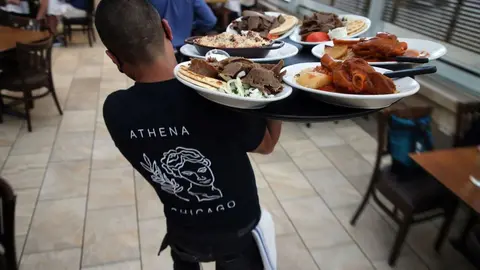
Mayor Brandon Johnson opposed the phasing out of the increase.
CHICAGO - The Chicago City Council voted to keep a subminimum wage for tipped workers, over the objections of Mayor Brandon Johnson.
The council voted 30-18 to keep the subminimum wage, which is below the veto-proof majority of two-thirds needed in the event of a veto by the mayor.
Brandon Johnson
The policy, known as the "One Fair Wage Ordinance," was passed in 2023 and required businesses that employ tipped workers like servers and bartenders, to pay them a higher wage each year until they reach parity with the city's standard minimum wage, which is $16.60 as of last year.
The backstory:Prior to the law's passage, employers were required to pay at least 60% of the city's hourly minimum wage, but as of July 1, 2025, that percentage increased to 76%. The proposal approved on Wednesday would freeze the percentage employers need to pay at 76%.
One Fair Wage
Some business owners and organizations have argued that the phasing out of the subminimum wage hurts businesses and threatens local service jobs and worker pay.
Ald. Samantha Nugent (39th Ward) argued the increase of the subminimum wage was well-intentioned, but has had a lot of "unintended consequences."
"At the end of the day, this has just driven up costs for local restaurants in every corner of the city," Nugent said. "Myself and many of my colleagues are hearing that restaurateurs just can't afford payroll, they can't afford to keep their doors open."
Illinois Restaurant Association
The Illinois Restaurant Association said in a news release that the most recent increase in the subminimum wage forced restaurants to "[scramble] to stay afloat," especially since full-service restaurant jobs remain well below pre-pandemic levels. The association said 89% of restaurants have increased their menu prices and 79% have had to cut workers' hours over the past year.
"The continued phase-out of the tip credit will cause irreparable damage to Chicago's world-renowned, independent, neighborhood restaurants, and to the dedicated workers they employ," said Sam Toia, President and CEO, Illinois Restaurant Association in a statement. "We need to freeze the tip credit and give our restaurants a fighting chance."
Opponents of phasing out the subminimum wage said restaurants were already required to ensure tipped workers made the equivalent of the standard minimum wage if their tips earnings fell short.
What to expect
The other side:But Johnson has argued for continuing to do away with the subminimum wage. In a social media post, his office said Johnson "will continue standing up for our tipped workers and One Fair Wage."
His office claimed that contrary to claims from opponents of the policy, restaurants are not leaving the city and that more than 1,500 new retail food establishment licenses have been issued in Chicago since July 1, 2024. More than 80% of restaurant licenses were renewed in both 2024 and 2025, according to the mayor's office.
At the end of the day, this has just driven up costs for local restaurants in every corner of the city.
Reading the wider picture
Openings get the attention, but it is the second and third year that decide whether a restaurant becomes part of a city's routine.
Key takeaways
- Prior to the law's passage, employers were required to pay at least 60% of the city's hourly minimum wage
- Some business owners and organizations have argued that the phasing out of the subminimum wage hurts businesses and threatens local service jobs and worker pay
- "At the end of the day, this has just driven up costs for local restaurants in every corner of the city," Nugent said
- The Illinois Restaurant Association said in a news release that the most recent increase in the subminimum wage forced restaurants to "[scramble] to stay afloat," especially since full-service restaurant jobs remain well below pre-pandemic levels
- "The continued phase-out of the tip credit will cause irreparable damage to Chicago's world-renowned, independent, neighborhood restaurants
By the numbers
- Fair Wage Ordinance," was passed in 2023 and required businesses that employ tipped workers like servers and bartenders, to pay
- Prior to the law's passage, employers were required to pay at least 60% of the city's hourly minimum wage, but as of July 1, 2025, that percentage increased to 76%
- More than 80% of restaurant licenses were renewed in both 2024 and 2025, according to the mayor's office
What people ask
What should you know about Illinois Restaurant Association?
The Illinois Restaurant Association said in a news release that the most recent increase in the subminimum wage forced restaurants to "[scramble] to stay afloat," especially since full-service restaurant jobs remain well below pre-pandemic levels.
What happens next?
In a social media post, his office said Johnson "will continue standing up for our tipped workers and One Fair Wage.".
All told
None of this settles the wider question. It does make one thing harder to ignore: the pressure in the dining room has shifted, and others will have to respond to it.