
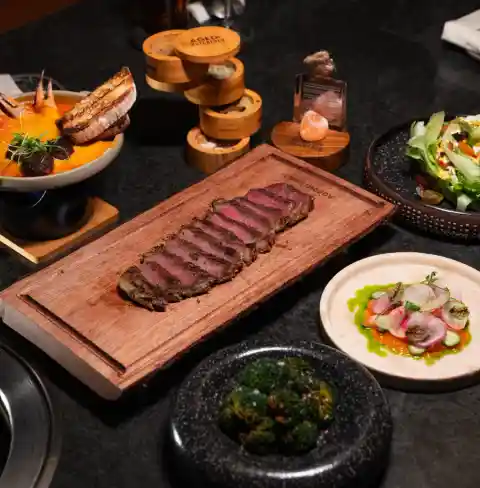
At Aged+Butchered Jakarta, time is an essential ingredient.
Sure, a steak might be cooked and served in minutes, but what happens before it's put to the grill is what really determines its flavour. At least, this is the philosophy that's followed at Aged+Butchered, where quality meats are afforded much attention before they are ever brought to the table.
A steakhouse with two passports
Serious steak lovers in Jakarta will be keenly familiar with this particular dining destination, which brings together two distinct cultures: the seriousness of an American steakhouse and the flair of an Asian yakiniku joint. In a city where loyalties are hard-earned, Aged+Butchered has stood the test of time since it opened in 2020, and speaking of time...
The balancing act is more delicate than it sounds. An American steakhouse asks you to trust the kitchen: the cut arrives whole, seared, rested and sauced, and the only decision left is how pink you like the middle. A yakiniku counter works the opposite way, handing over the tongs, cutting the beef into small, quick-cooking pieces and turning dinner into something closer to a conversation. Aged+Butchered borrows the patience of the first and the theatre of the second, ageing its beef for weeks on end and then finishing it right in front of you.
That hybrid model also explains the mood of the room. It is composed enough for a business dinner and relaxed enough for a Friday night, which is a rare combination in a city where restaurants usually pick a lane and stay in it.
The ingredient you cannot buy
This is perhaps Chef Andri Dionysius' most important ingredient.
A proper steak starts with an understanding of everything that happens before it is cooked.
Those are the words of the Chef Patron of MDA Restaurant, who has amassed one of the most impressive 'meat libraries' in the city at Aged+Butchered.
Calling it a library rather than a cellar or a walk-in fridge is deliberate. A library implies cataloguing, patience and a point of view; every cut held in it has been chosen for a reason, logged, and then left alone until it is ready to be read.
Whilst the restaurant places strong emphasis on sourcing some of the world's most premium meats - Pure-bred Japanese Black Wagyu MS 9+ among them - it's how the restaurant suitably ages and prepares them that makes all the difference. One could say it's the steakhouse equivalent of 'money doesn't buy class.'
Anyone with a large enough budget can buy exceptional beef. Far fewer operations have the refrigeration, the humidity control, the trimming discipline and - most of all - the nerve to leave capital sitting in meat that will not be sold for another three months.
What actually happens in the ageing room
This is most visible in the ageing room, where selected cuts are left to gain depth, texture and character under carefully managed conditions. Some meats are dry-aged, enhancing the intensity of the meat's characters, where natural nutty and umami flavours develop; whilst others are wet-aged, improving juiciness, tenderness and natural sweetness. These are aged anywhere between 30 to 180 days.
The two methods are not rivals so much as different answers to different questions.
- Dry-ageing exposes the beef to carefully controlled airflow. Moisture leaves the muscle, flavour concentrates, and naturally occurring enzymes go to work on the tissue. Expect a firmer bite and a nuttiness that borders on blue cheese.
- Wet-ageing seals the cut in vacuum packaging so that nothing is lost. The beef stays juicy and sweet, and the tenderness comes from time rather than from evaporation.
- Neither is simply better - and that is rather the point. A lean, muscular cut rewards dry-ageing, while an already well-marbled one often only needs wet-ageing to relax.
The choice also carries a literal cost. Dry-aged beef loses weight to evaporation, then loses more when the hardened outer layer is trimmed away before cooking, which is why those steaks always read higher on a menu than their wet-aged neighbours.
Signature-Aged: when the ageing room gets playful
But the Chef and his team take things a little further, introducing their 'Signature-Aged' steaks, where more experimental processes develop unique flavours: like the 45-day Camembert-aged Ribeye, or others aged in whisky and port. The 365-day Wagyu Ribeye (Bone-in, MS7) is the longest aged selection in the restaurant, for those curious to know what Father Time can do.
Camembert-aged beef sounds like a stunt until you think it through: the same cultures and fats that give a ripe wheel of cheese its aroma go to work against the fat cap of a ribeye, and the result leans savoury rather than funky. Whisky and port take the opposite route, lending sweetness and a faint smokiness to meat that already has plenty of character of its own.
And then there is the one-year ribeye. A 365-day dry age is well past the point most kitchens would consider sensible; it is the sort of thing a restaurant does because its ageing programme can absorb the risk, not because it expects to sell it every night.
The last ten minutes belong to the grill
The diverse menu has a meat for everyone's fancy, with the ageing process coming to completion through tableside grilling, where diners can watch (and smell!) as their steaks sizzle, fat slowly and gorgeously rendering, to their preference of doneness. Pink Himalayan salt is the seasoning of choice, allowing each cut - and its age - to speak for its self.
Tableside service changes the rhythm of the meal. Courses arrive when you are ready rather than when the pass is ready, conversation has room to breathe between cuts, and the entire point of spending ninety days on a steak - the smell of it hitting a hot surface - becomes part of the evening rather than something that happened behind a swing door.
Serving the salt separately, and keeping it simple, is a statement in itself. Once a steak has been aged for four months, peppercorn sauces and compound butters are mostly noise.
How to read the menu like a regular
For diners new to aged beef, the temptation is to order the most expensive thing on the page. A more rewarding approach is to order for contrast.
- Start with a shorter age. A 30- to 45-day cut gives you the house style without overwhelming the palate.
- Put a Signature-Aged cut next to it. Tasting the Camembert-aged ribeye alongside a wet-aged one is the fastest way to understand what all that time actually buys.
- Ask about the marbling score. MS numbers describe how much intramuscular fat a carcass carries; the higher the score, the richer and softer the beef, and the less aged flavour it needs to stay interesting.
- Taste the fat first. Much of what dry-ageing produces lives in the fat rather than in the lean, so the first bite tells you the most.
- Take it on the rarer side. Heavily aged beef is already concentrated; pushing it past medium tends to flatten everything the ageing room built.
None of this requires expertise. The staff talk about ageing curves with the ease of people who have had this conversation ten thousand times, and the best meals here tend to begin with a question rather than an order.
From Jakarta to Canggu
Aged+Butchered remains a favourite amongst Jakarta's steak connoisseurs, likely due to the restaurant's dedication to its craft, promising a consistently high-quality meat experience. In 2024, the brand expanded to Canggu, Bali, where its continued philosophy has also built up a strong following among island diners.
The move made sense. Bali's dining public is more transient than Jakarta's but far more international, and a restaurant whose pitch is written in the universal language of grilled beef travels better than most.
Getting better with age
As restaurants come and go in Jakarta, this enduring steakhouse proves that, like its meats, things do indeed get better with age.
Six years is a long life for a restaurant in a market where new concepts are routinely declared the next big thing and quietly replaced a year later. What Aged+Butchered sells, in the end, is not beef so much as patience - months of it, applied quietly, in a room that most guests never see. The steak is simply where that patience finally becomes visible.