
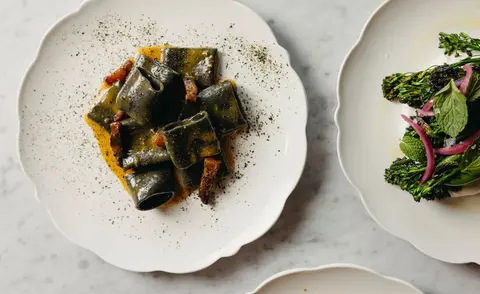
From kimchi-filled pasta to black truffle soft serve, this new Koreatown restaurant truly blends the best of both worlds
In the heart of Los Angeles's Koreatown, one might not be expecting to find a restaurant where traditional Italian classics are recreated through the lens of Korean ingredients, but that unique culinary mash-up is exactly what you will find at Lapaba - a portmanteau of La Pa(sta) Ba(r). As the brainchild of owner and beloved local restaurateur Robert Kim, who was inspired by Korean café culture and Italian pasta bars to create a unifying concept that is simultaneously unexpected and yet familiar.
Kim also had help from the 'Queen of Pasta' Nancy Silverton, of Michelin-starred Osteria Mozza and Pizzeria Mozza fame, who worked as a consultant on the project. More Mozza alumni came aboard, with husband-and-wife chef duo McKenna Lelah and Matthew Kim bringing this delicious Korean-Italian eatery to life.
Wallpaper* dines at Lapaba, Los Angeles
The mood: a pasta bar with a Korean soul
Mozza and Pizzeria Mozza
George Kelly, founder of Kelly Architects, began working on the project with Robert Kim in 2021, following his first visit to the abandoned historic building, which required a complete ground-floor renovation.
The furniture and interiors were produced in Italy by Costagroup in collaboration with the architects. A central counter spans the room in fluted oak, topped with polished Carrara marble. Large-format stone flooring, smooth plaster walls, and vertically-laid ceramic tiles complete the palette. The lighting scheme combines sculptural pendant fixtures that highlight the materials and architectural geometries - including an interior window, framed in emerald green tile, where diners can see their pasta being made.
Rather than relying on artwork, the space draws expression from its architectural textures and custom details, from the bamboo-clad bar front to a rope-like light fixture hanging from the ceiling. Keepsakes and decorative objects line the shelves, while a wall display of more than 300 bottles anchors the bar at the front of the restaurant.
Kelly Architects
The food: a seamless blend of two of the world's most compelling cuisines
Kim has been instrumental in bringing a series of food and beverage concepts to this pocket on the western edge of Koreatown. At Lapaba, the pasta-making process is fully on display, from sheeting and cutting to hanging.
Classic pasta forms the menu's foundation, but with a Korean twist. There's orecchiette with sausage, cheesy corn agnolotti, and the option to elevate dishes with an Orra caviar supplement of sustainably sourced Siberian sturgeon.
Korean
Elsewhere, Italian staples are reworked with Korean ingredients - supplì filled with kimchi and Spam; rice cakes dressed in cacio e pepe; and Korean fried chicken lifted with Calabrian chili heat. To finish, opt for the black truffle soft serve or a line-up of soju-matcha cocktails, options that demonstrate Lapaba's irreverent blend of precision and playfulness.
Lapaba is located at 558 S Western Ave, Los Angeles, CA 90020, United States
From kimchi-filled pasta to black truffle soft serve, this new Koreatown restaurant truly blends the best of both worlds
The wider picture
Location, rent and staffing shape restaurant stories long before the food does, and the operators who last are the ones who plan around all three.
What to remember
- Kim also had help from the 'Queen of Pasta' Nancy Silverton, of Michelin-starred Osteria Mozza and Pizzeria Mozza fame, who worked as a consultant on the project
- The furniture and interiors were produced in Italy by Costagroup in collaboration with the architects
- Kim has been instrumental in bringing a series of food and beverage concepts to this pocket on the western edge of Koreatown
- Elsewhere, Italian staples are reworked with Korean ingredients - supplì filled with kimchi and Spam; rice cakes dressed in cacio e pepe; and Korean fried chicken lifted with Calabrian chili heat
- Lapaba is located at 558 S Western Ave, Los Angeles, CA 90020, United States
All told
Every change in the dining room eventually reaches the same test, which is whether people keep choosing it once the novelty has worn off.